From Wat to Wonder | Finding Peace in Bangkok’s Temples
It was just after midnight when I arrived in Bangkok, stepping into the warm, humid buzz of Thailand’s capital. My transfer guide met me at the international airport with a quiet smile and, on our way to my accommodation, offered suggestions to help me make the most of my short stay, just one full day and two nights to uncover a glimpse of this extraordinary city.
My accommodation was tucked in the Banglampu district, within walking distance of the ever-buzzing Khao San Road. I was about to spend a night in the heart of a vibrant, slightly chaotic hub of Bangkok. And as I’d soon discover, it also sat within easy reach of many of the city’s most treasured temples, the Grand Palace, Wat Phra Kaew, Wat Pho, and a handful of smaller, less visited temples.
That night, I met a fellow traveller who was also travelling in the same small group tour, and we agreed to meet the next morning to explore Bangkok’s sacred heart together.
Bangkok is home to hundreds of temples, each a small sanctuary of golden quiet amongst the city's steady pulse. Many cluster along the banks of the Chao Phraya River or its winding canals, echoing a long-standing belief in Thai Buddhism that monks should be ordained near water, symbolising purification and spiritual cleansing.
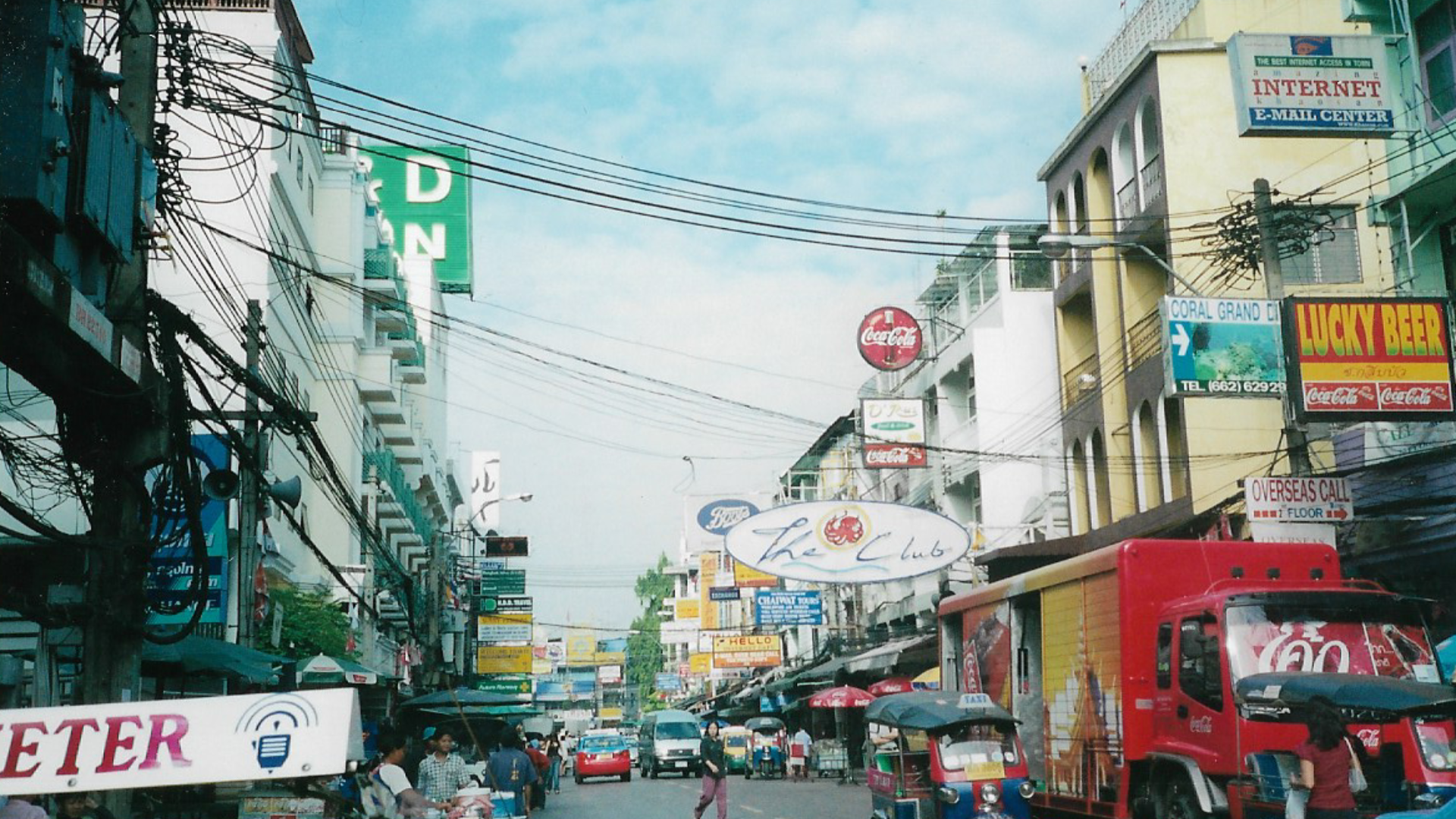
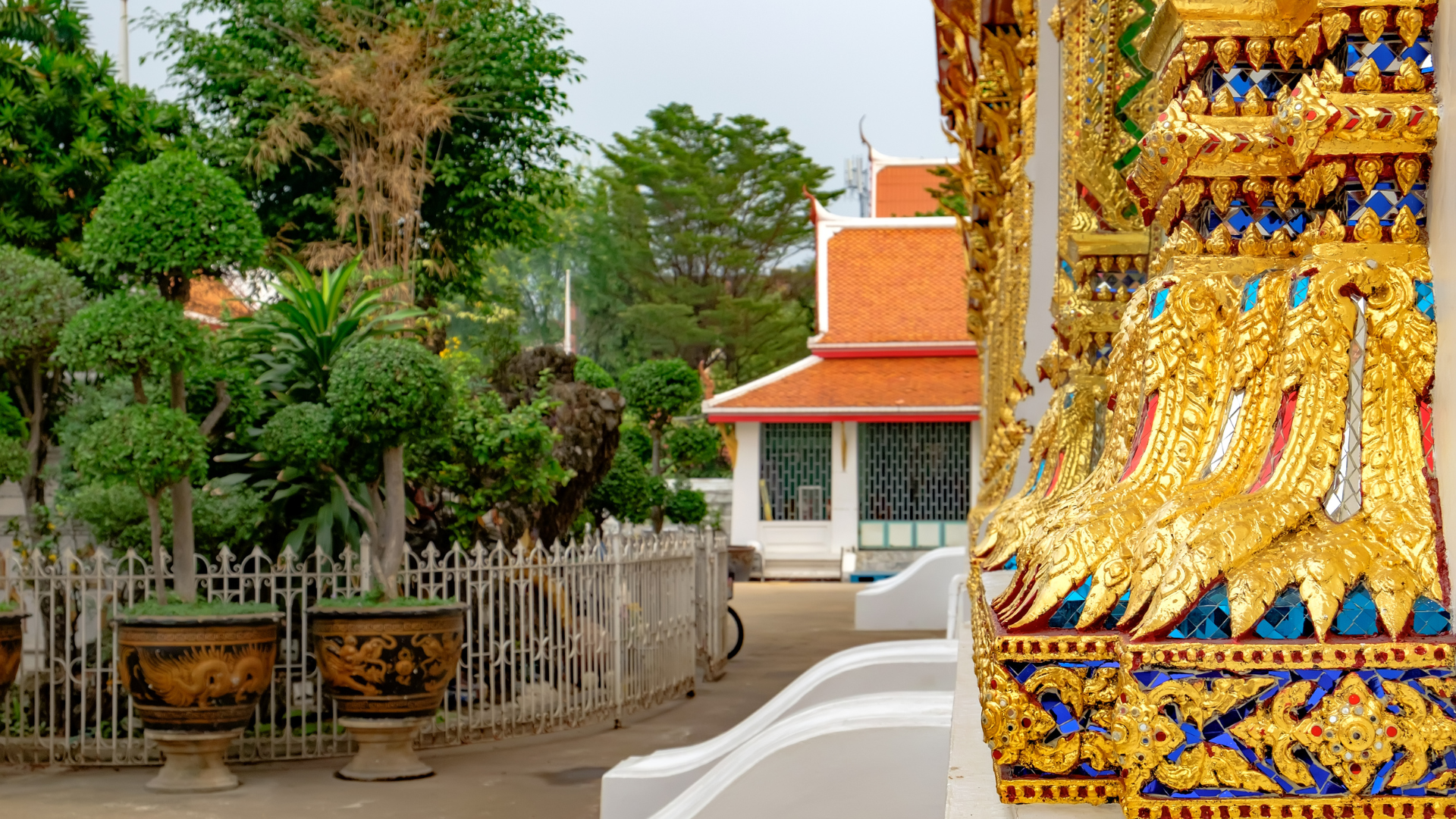
After a quick bite of Pad Thai for breakfast from a street vendor on Khao San Road, we wandered down the road and stumbled upon a small, yet timeless and sacred temple, Wat Chana Songkhram Rachawora Mahawiharn, more commonly known as Wat Chana Songkhram.
Just outside the temple, we watched a quiet ritual unfold. Locals were purchasing tiny caged birds, whispering a wish, and releasing them into the air. It’s a traditional gesture in Thai Buddhism, one of compassion and karmic renewal, and is believed to bring good fortune through the simple grace of setting life free. These small, symbolic offerings are known as merit-making and are deeply woven into Buddhist practice. They help purify one’s mind and support spiritual progress toward enlightenment. Merit can be made in many ways, by offering food to monks, donating to temples, or releasing animals like birds or fish. Each path is a gesture of kindness that benefits both the giver and the greater whole, helping to purify the mind and support spiritual progress toward enlightenment.
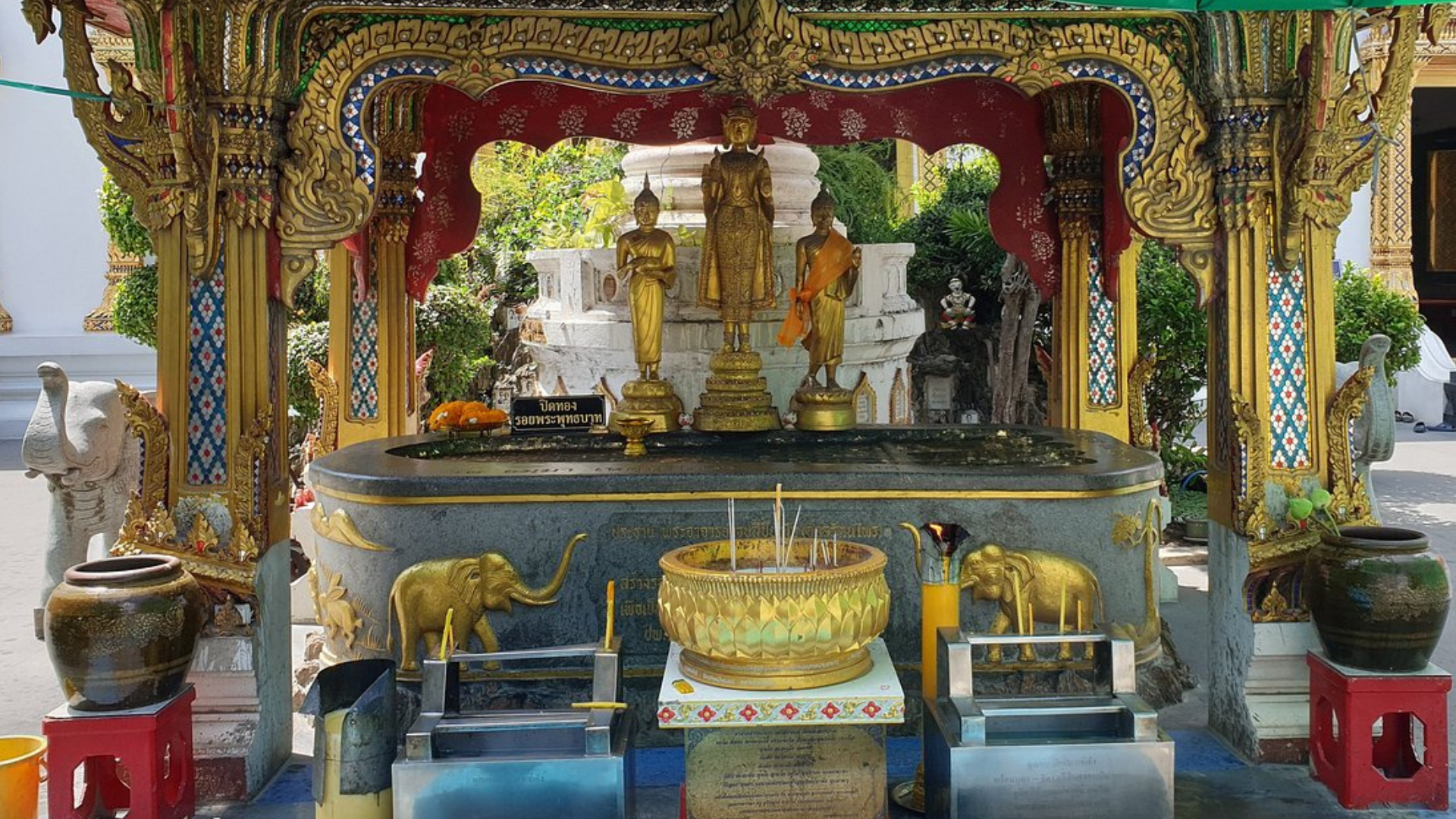
As you enter the temple grounds, a small shrine invites quiet contemplation. I paused to light a candle and placed it among the others.
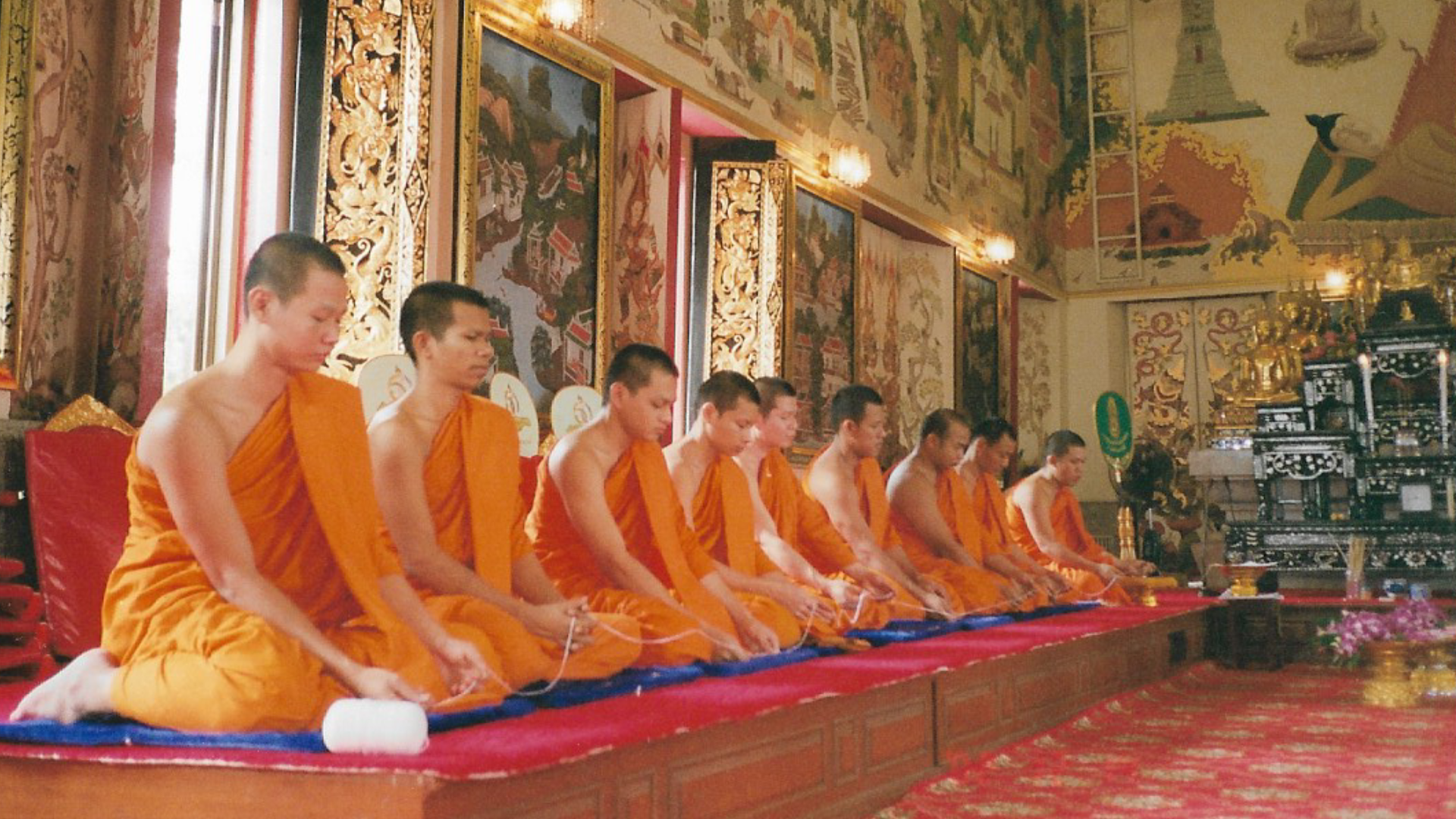
Inside the temple, we were welcomed by the serene sight of a prayer session already in motion. Nine monks, wrapped in saffron robes, knelt gracefully on a rich blue velvet cloth. They sat in a straight line, each holding a length of white thread between their hands, an unbroken connection, passed from one monk to the next.
It was quiet, respectful, and unexpectedly moving. We were graciously allowed to take a photo; a small act of generosity that made the moment feel even more meaningful. It’s one of those memories that settles quietly into your consciousness, forever unforgettable.
Later, I learned more about where we had unintentionally found ourselves. Wat Chana Songkhram, nestled in the Banglampu district, is more than just a peaceful sanctuary tucked between buzzing streets, it’s steeped in national history.
Originally known as Wat Klang Na, meaning “temple in the middle of the field,” this sacred site dates back to the Ayutthaya period, long before Bangkok rose to become Thailand’s capital. The surrounding region, once part of the ancient Sukhothai Kingdom, the first capital of Siam during the 13th and 14th centuries, holds some of the earliest expressions of Thai architectural and spiritual heritage.
The temple gained renewed importance during the reign of King Rama I in the late 18th century. Around 1782, as the Rattanakosin Kingdom was founded, the king invited the Mon people, who were renowned for their Buddhist devotion and temple craftsmanship, to what is now modern day Bangkok. He commissioned the temple’s restoration and renamed it Wat Chana Songkhram, the “Temple of Victory in War,” honouring Siam’s success in repelling Burmese invasions across three pivotal battles between 1785 and 1787.
Its structure became a second class royal monastery and a spiritual sanctuary for the Mon community, who played a vital role in both defending the kingdom and preserving Theravāda Buddhist tradition. Today, the temple still holds that quiet, resilient strength, as a place of prayer, remembrance, and calm nestled just beyond the city’s persistent hum.
Leaving the Wat Chana Songkhram temple and armed with a local map, we set off in search of the Grand Palace and Wat Pho. Let’s just say… my skills in navigating Thai street maps left something to be desired. We found ourselves heading in the wrong direction before being rescued by a kind local, who kindly flagged down a tuk-tuk driver to help us make better use of our limited time.
Our driver, Saim Phao, became our cheerful guide for the next part of the day.
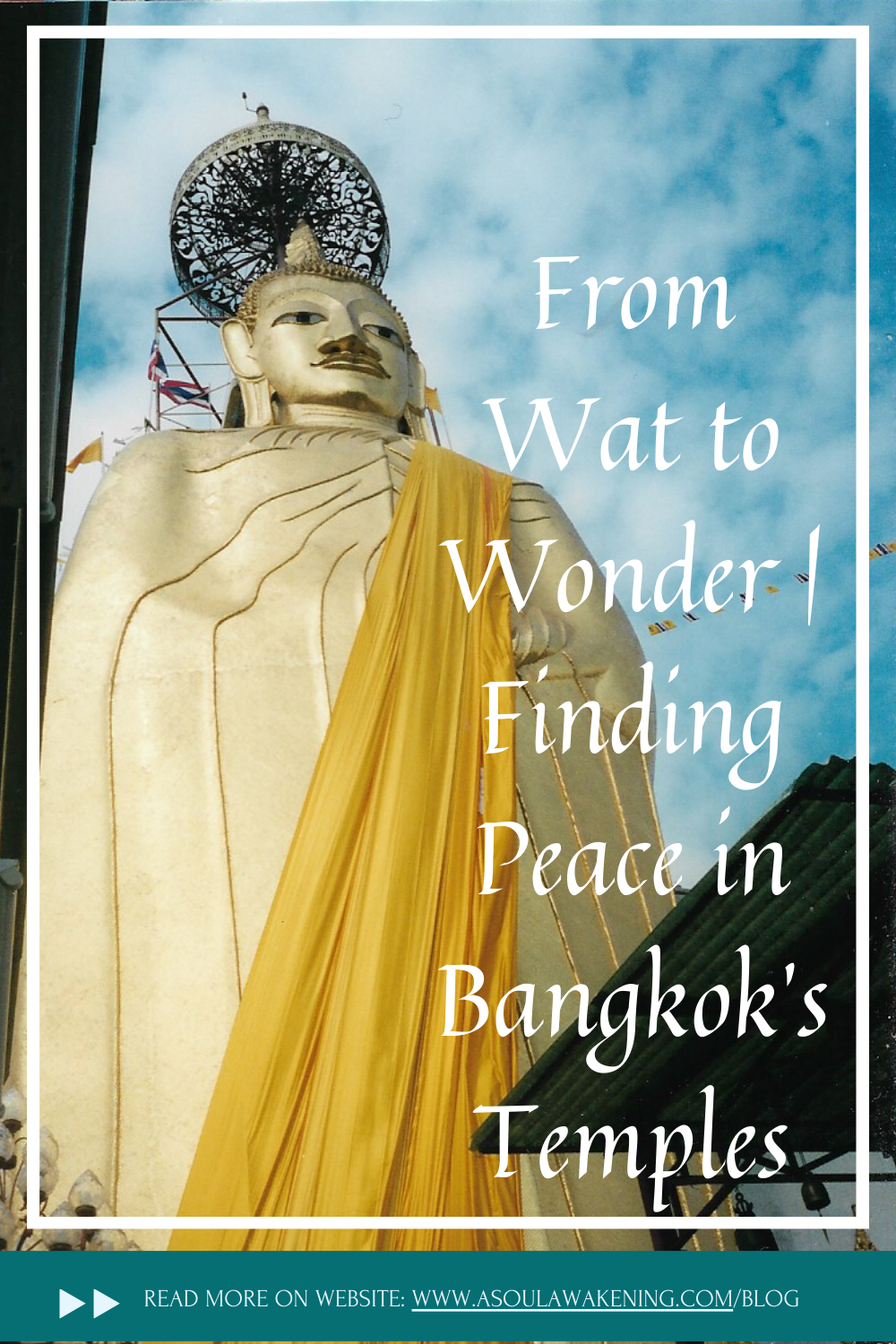
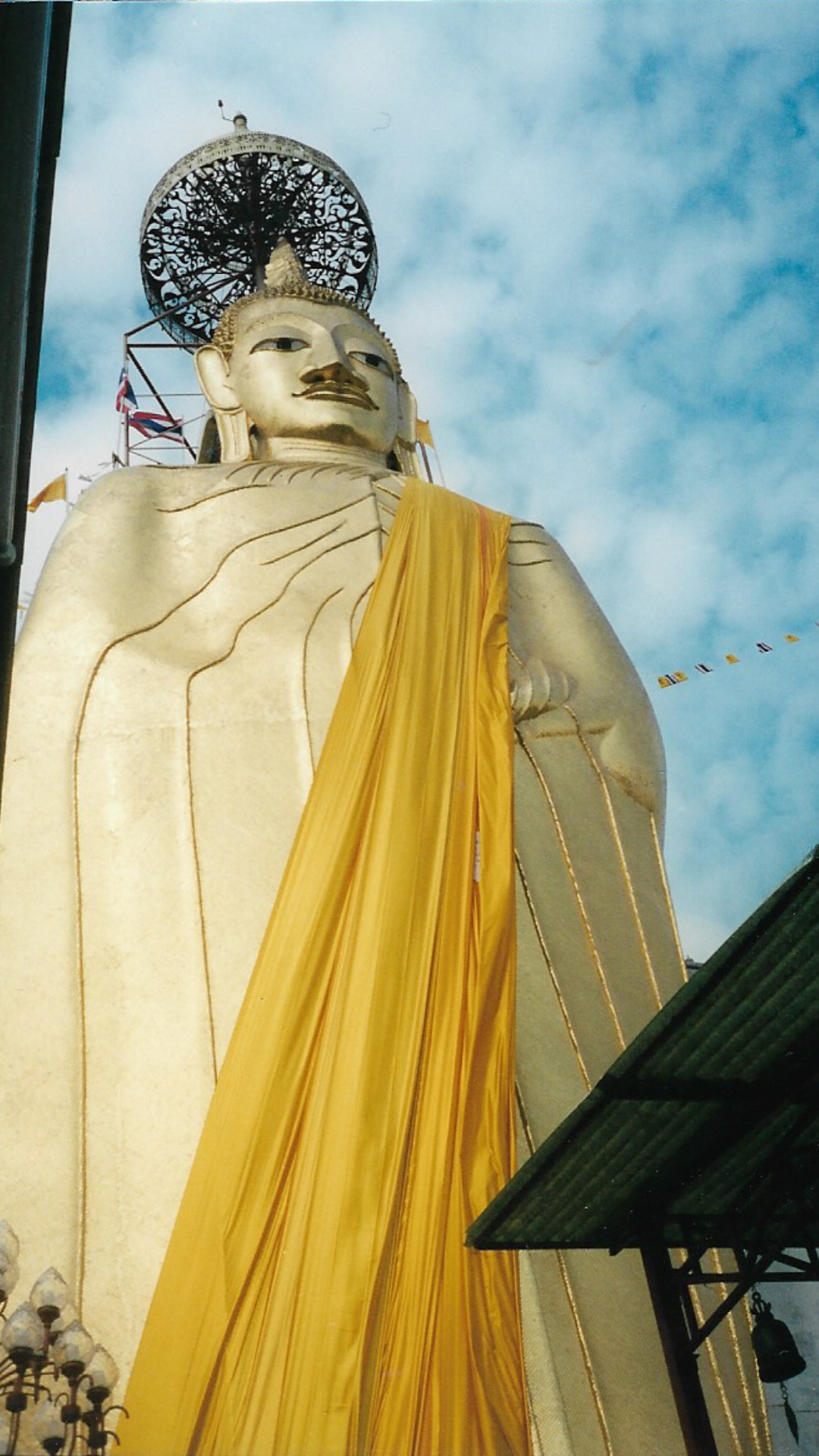
First stop, Wat Intharawihan, often referred to as the Standing Buddha. Towering 32 metres high and 10 metres wide, the statue is an imposing presence. Covered in gleaming gold and crowned with a topknot crafted from 24-carat gold, it’s impossible to miss, yet surprisingly, many first time visitors are unaware of its full story.
Construction of this remarkable Buddha statue began during the reign of King Rama IV in the mid-19th century but wasn’t completed until the 20th century, under Rama VII.
The statue represents Luang Pho To, a revered monk, and stands in the Abhaya Mudra, the gesture of reassurance, protection, and fearlessness. The temple itself, Wat Intharawihan, has been a place of worship since the late Ayutthaya period and continues to be a deeply spiritual site. Locals continue to visit regularly, offering flowers, incense, candles, and even small bottles of oil to fuel the eternal lamps.
Near the entrance, a woman patiently wrapping orchid blossoms into neat, fragrant bundles, an offering of beauty and reverence. The gentleness and grace that lives at the heart of Thai spiritual tradition.
This unexpected detour became a quiet highlight of the day, an opportunity to pause, reflect, and stand at the feet of something both grand and grounding, well away from the bustle of Bangkok’s more crowded temples sites.
Enroute to our next stop, a thirty-minute drive weaving through the bustling streets of Bangkok, Saim, our driver, made three unexpected stops. A couple of Thai silk shops and a jewellery shop found their way onto the itinerary. As I later learned, this is a fairly common occurrence with Bangkok tuk-tuk drivers, and to be honest, I didn’t really mind. At the second Thai silk shop, a beautiful little throw cushion cover caught my eye. I still have it with me; a small, silky memory that blended into the story of that day.
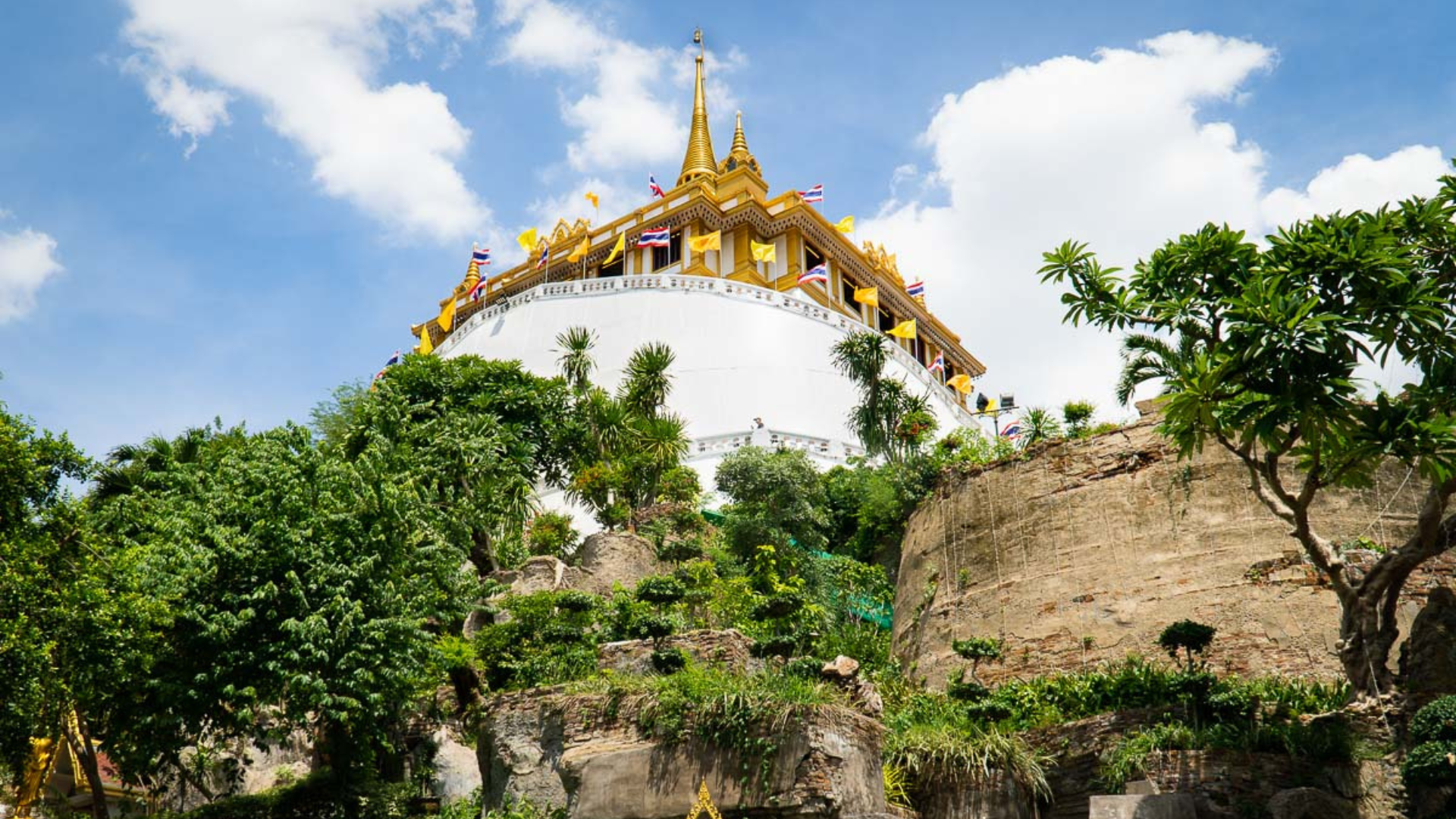
Then it was on to Wat Saket, more commonly known as the Golden Mount or Phu Khao Thong, a visit that felt both grounding and grand.
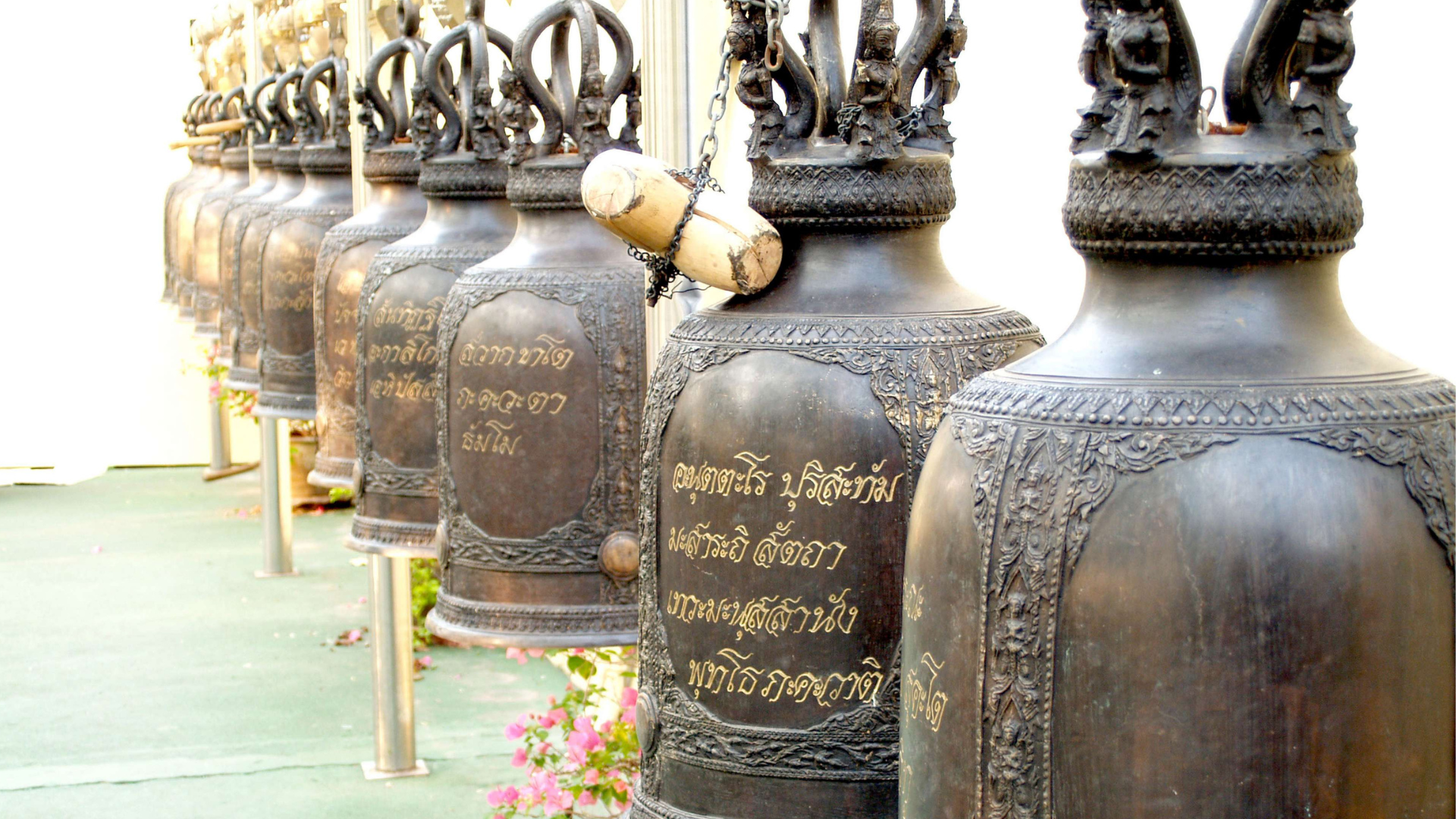
Climbing the spiralling path up the mount was an experience in itself. Along the way, you pass rows of bells, gongs, and shrines, their quiet presence offering an invitation to pause. It’s a walk that lets you slow down, the kind of visit that rises gradually above the clatter of Bangkok below.
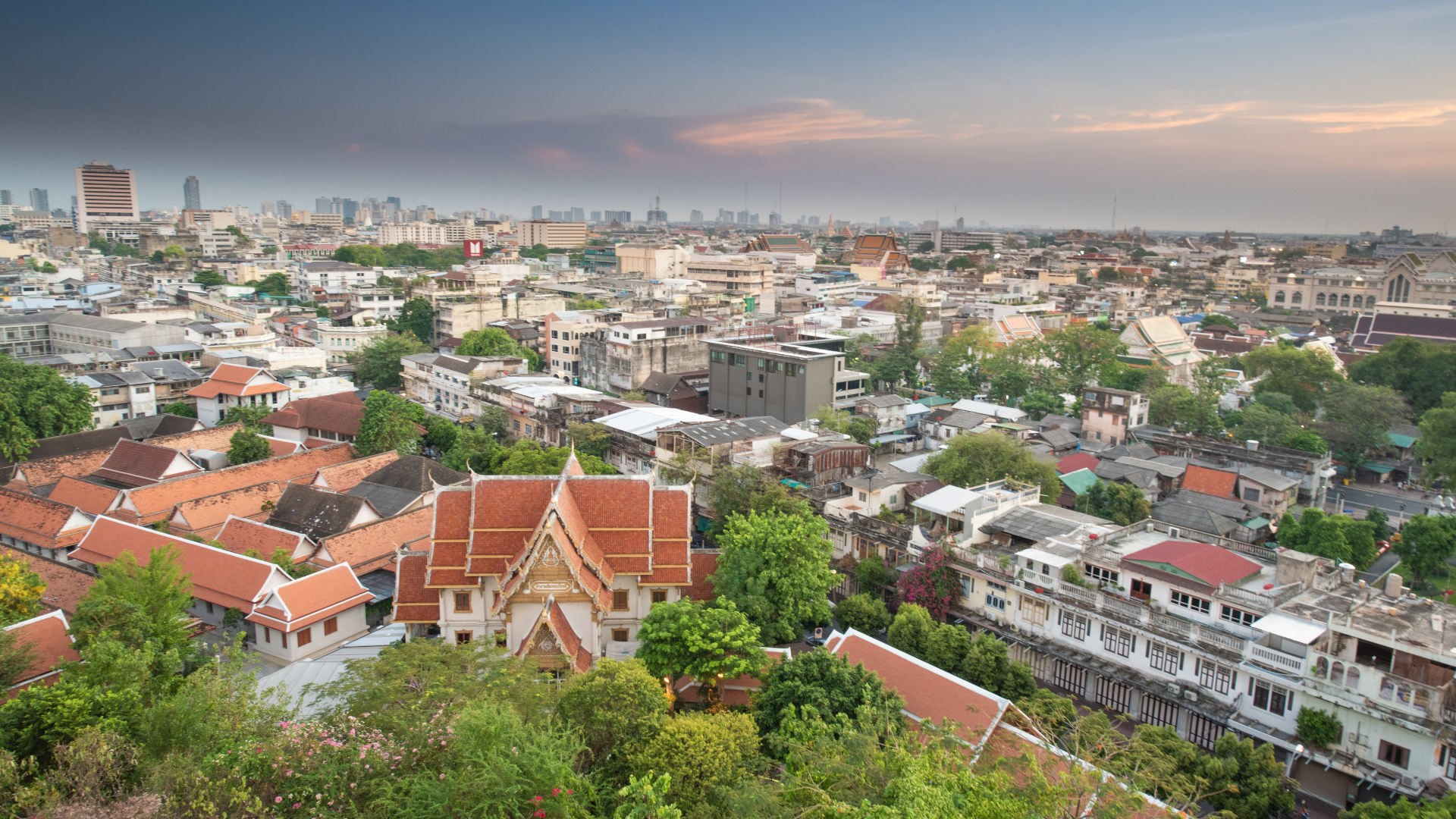
When you reach the top, you’re rewarded with panoramic views stretching across the city. The historic rooftops of old Bangkok lie in the foreground, giving way to the modern high-rises towering in the distance, a striking contrast of old and new.
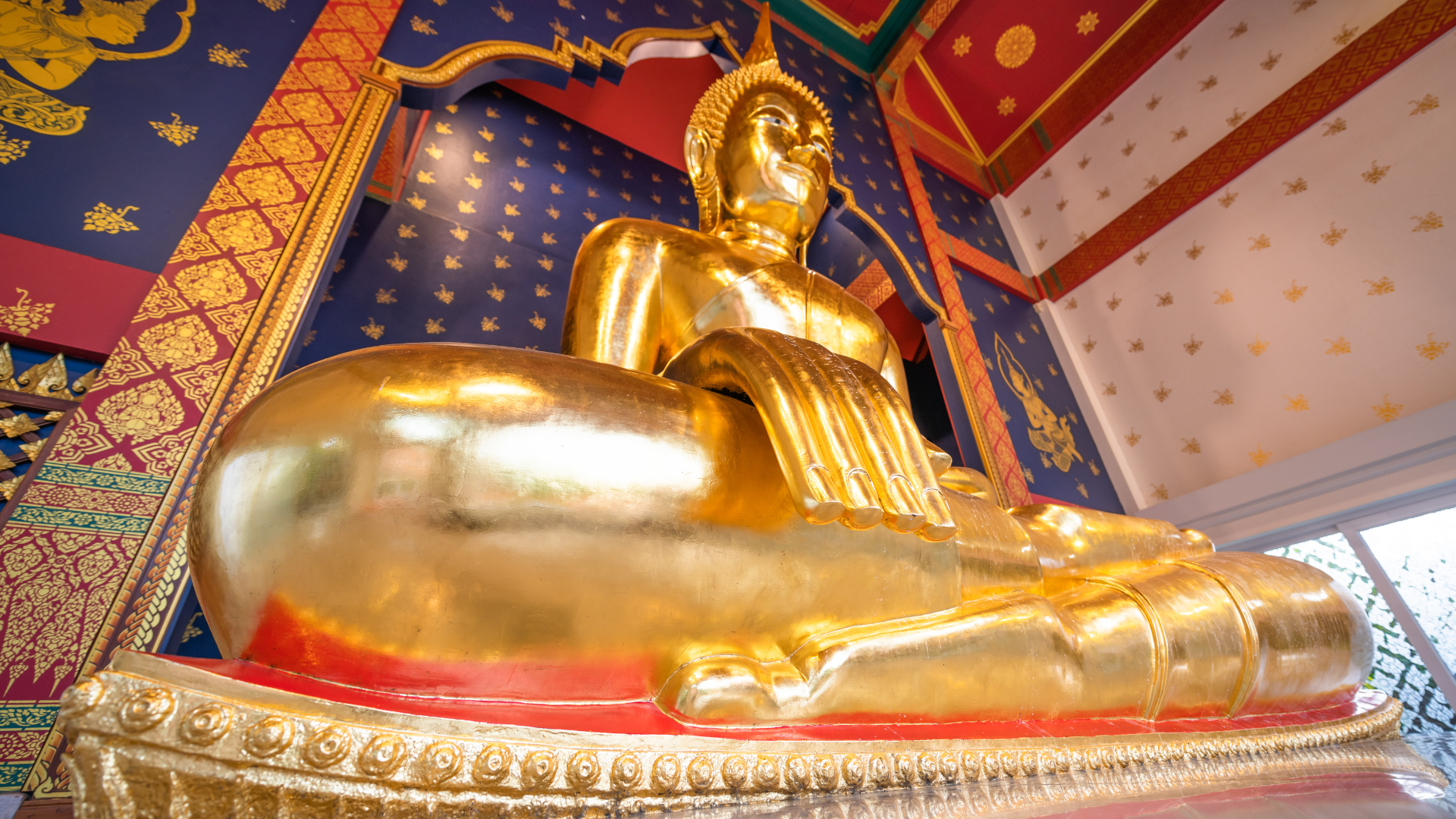
Inside the golden chedi, a term often used for a Buddhist stupa or temple, a large cross legged seated Buddha rests in quiet stillness. The entire space feels steeped in spiritual weight, yet somehow light.
Wat Saket’s history reaches also back to the Ayutthaya period, but the Golden Mount itself was constructed during the early Rattanakosin era under King Rama III. The artificial hill was originally intended to be a grand chedi, but the soft soil couldn’t support the weight. Over time, the collapsed structure formed a natural looking hill, which was later reinforced and crowned with a gleaming golden chedi under King Rama IV. Today, it houses several of the Buddha, in various postures, along with shrines where locals leave offerings of flowers and incense, a quiet devotion woven into the rhythm of daily life.
It’s also remains one of the most cherished temples in the city, not just for its history, but for the peacefulness it offers, quite literally above the chaos. For me, Wat Saket offered that ideal balance between exploration and reflection, the sort of place that leaves you quietly uplifted.
We’d clearly stayed longer than our tuk tuk driver, Siam, had anticipated. When we returned to the entrance, he was nowhere to be seen, though not without making arrangements. Ever thoughtful, he’d lined up another driver to take his place. After a few minutes of good natured haggling with the replacement driver, we managed to convince him that we didn’t want a car, we wanted a tuk tuk. Part of the experience, after all.
By now, we were well and truly ready for food. A short ride brought us to the Grand Palace area, where we took a quick stroll along the street to track down something tasty. I found exactly what I needed: a street vendor dishing up crispy fried wontons and golden spring rolls with a generous side of sweet chilli sauce. I also couldn’t resist picking up a few pieces of pa tong ko, those wonderfully moreish Thai donuts, crisp on the outside, soft in the middle, and slightly sweet without being over the top.
Meeting with my travel companion, who had stopped to buy a watch and a sarong, the sort of spontaneous purchases that seem to happen so easily when you're travelling. With a light and satisfying lunch behind us, we crossed the road and made our way toward one of Thailand’s most iconic landmarks: The Grand Palace, a sprawling complex that has stood as the heart of Thai royalty since 1782. Spanning over 218,000 square metres, the palace is a tapestry of lavish buildings, sacred temples, and meticulously manicured courtyards.
After purchasing our entry tickets, we joined the steady stream of visitors moving toward the gates. As expected, the palace guards stood watch, ensuring everyone met the strict dress code. I was stopped almost immediately; my legwear wasn’t long enough. Thankfully, my travel companion’s new sarong came to the rescue, quickly wrapped around me and saving the moment.
But no sooner had I passed that checkpoint than I was stopped again. This time, for not having closed shoes. Apparently, sandals, even neat ones, weren’t up to palace standards. So, with an eye roll and a quiet chuckle, I found myself buying a pair of socks and handing over 100 baht as a deposit for some, strappy loan shoes. Whether it was an actual regulation or just a quietly efficient tourist ‘sideline,’ who knows? Either way, properly attired at last, we continued on towards the entrance, slightly flustered, a bit bemused, but excited to explore the grandeur that awaited us.
One of the most striking aspects of the Grand Palace is the sheer number of temples and religious buildings nestled within its golden embrace. But this isn’t simply a case of architectural grandeur for grandeur’s sake.
When the Grand Palace was established in 1782 by King Rama I, founder of the Chakri Dynasty, it was designed not only as a royal residence but also as the spiritual and administrative heart of the newly formed Rattanakosin Kingdom. Its design drew inspiration from the grand palace complexes of Ayutthaya and Sukhothai, both former capitals of Thai civilisation.
Much like the ancient cities of Ayutthaya and Sukhothai before it, the palace complex was laid out as a reflection of the universe, shaped by Buddhist and Hindu cosmology. Within this symbolic landscape, each temple and sacred structure plays a role in mirroring celestial and spiritual order. A miniature universe with Mount Meru at its centre, surrounded by mythical beings, celestial realms, and protective guardians.
Although no longer the primary residence of the Thai royal family, who now reside elsewhere, the Grand Palace remains the ceremonial and spiritual heart of the monarchy. It continues to host major state occasions, royal rituals, and sacred Buddhist observances, including those within Wat Phra Kaew, home to the revered Emerald Buddha.
Once inside the Grand Palace complex, the grandeur and vastness of the surroundings unfold before your eyes, an overwhelming array of intricate rooftops, golden spires, and richly adorned halls that shimmer with the light of the sun.
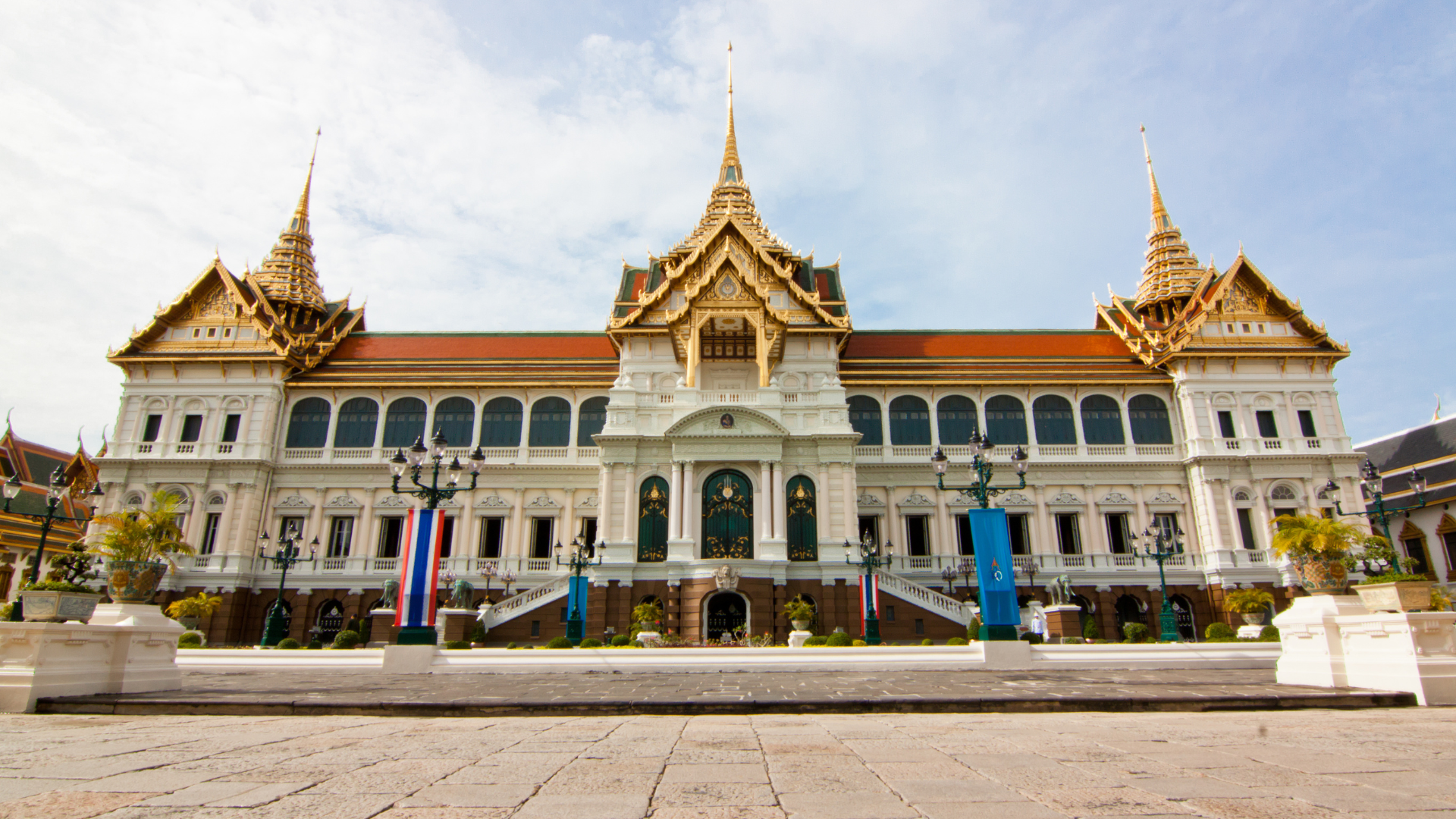
Passing the commanding presence of the Phra Thinang Chakri Maha Prasat, the Grand Palace’s royal residence blending traditional Thai and European architecture, we made our way towards the heart of the complex.
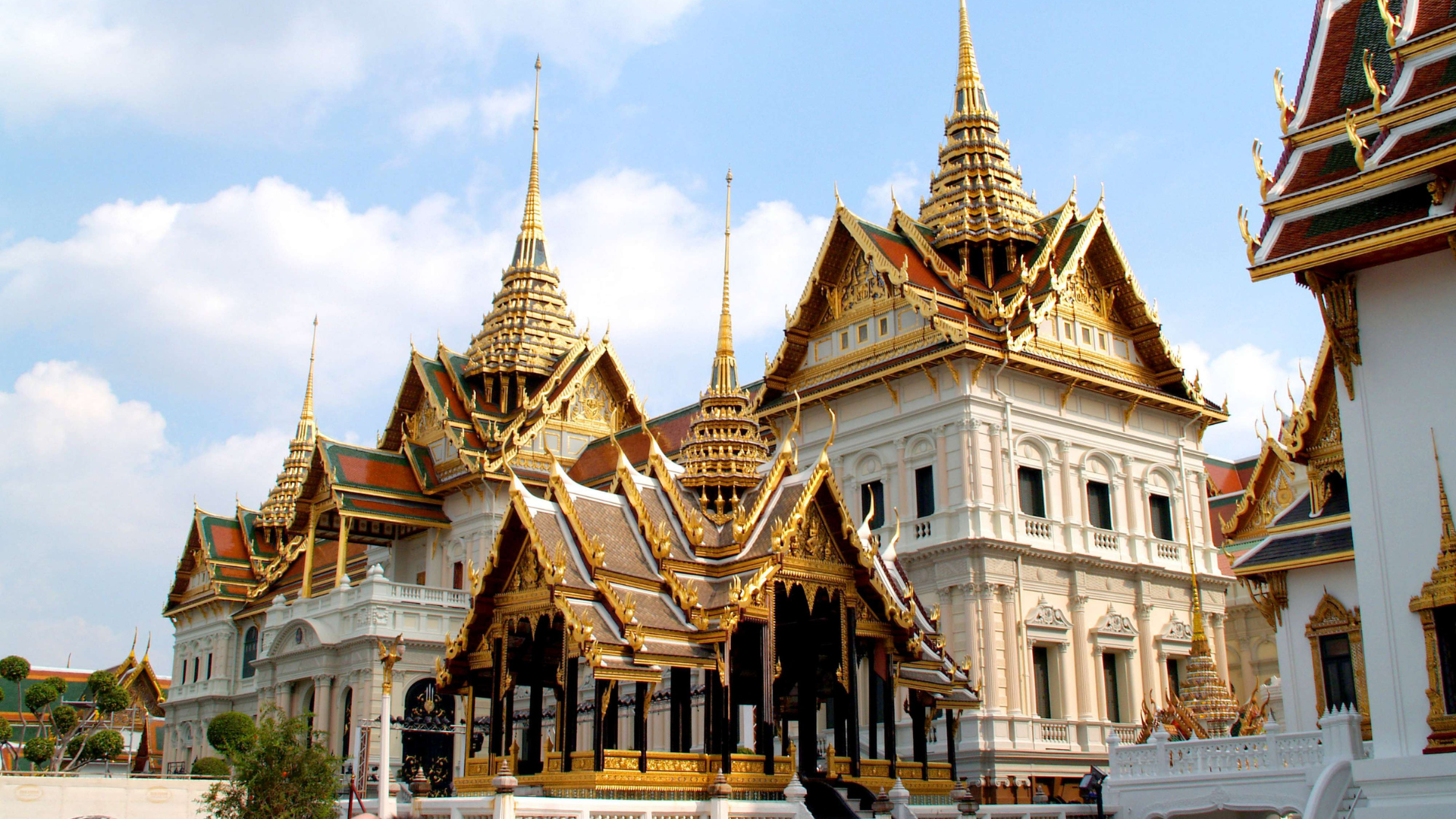
At the centre of the Grand Palace complex sits Wat Phra Kaew, the most sacred temple in Thailand, housing the Emerald Buddha, and considered to be the symbolic guardian of the kingdom. Surrounding the temple are numerous chapels (viharns), pavilions (mondops), shrines (prasats), and chedis (stupas), each constructed over time by successive kings. Serving to commemorate key events, house royal ashes, enshrine sacred relics, and provide ceremonial spaces for monks and the royal family.
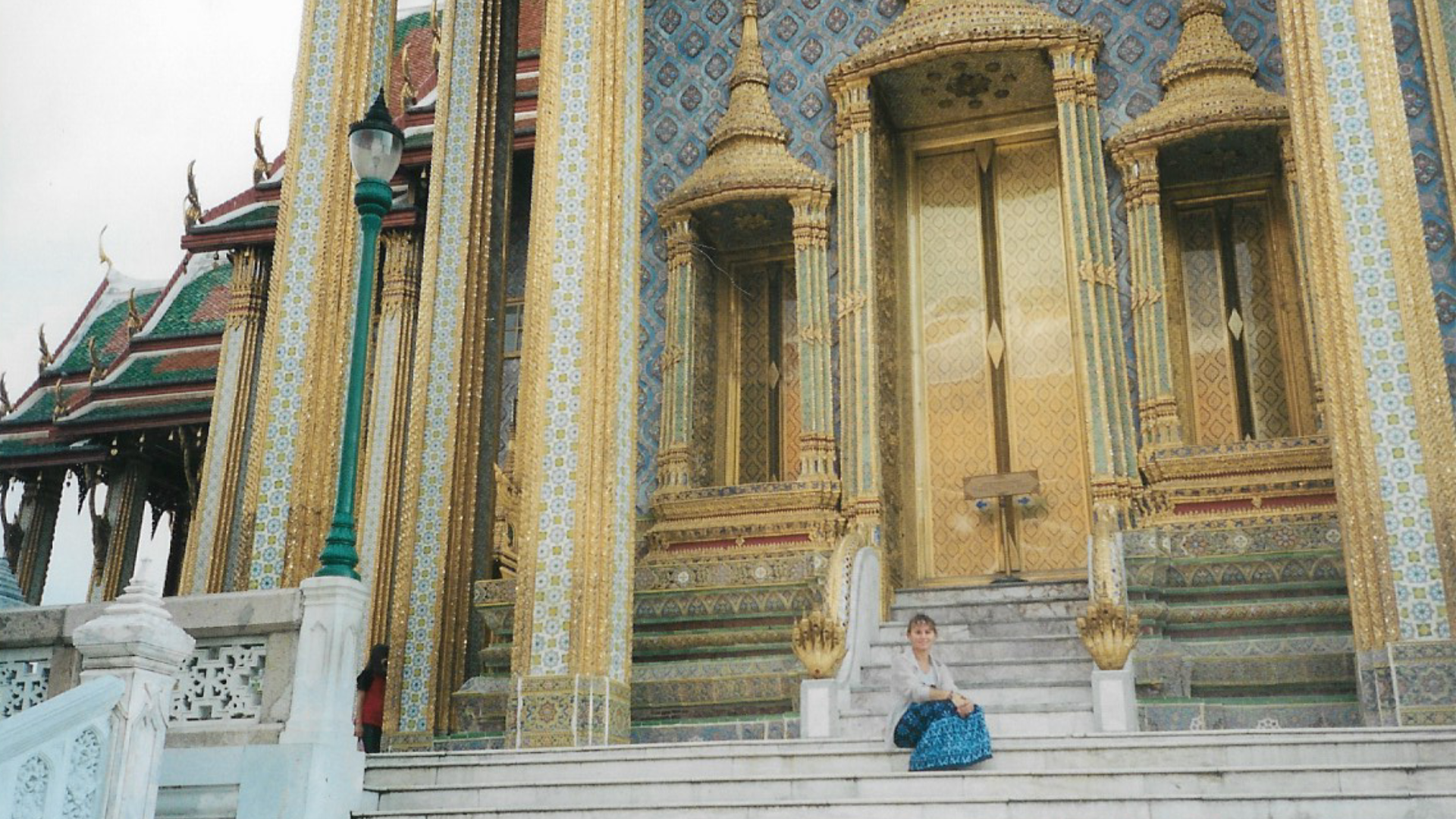
Amid the grandeur of Wat Phra Kaew, it was the stillness of a single moment that lingered with me most.
Seated on the steps of the Ubosot, the ordination hall at Wat Phra Kaew. I found myself pausing beneath a marvel of gold and glass mosaic that shimmered in the early afternoon light. This sacred structure, the spiritual heart of Thailand's most revered temple, houses the Emerald Buddha and is reserved for the most significant royal and monastic ceremonies. Its gilded doorways and intricate mirrored tiles speak not just of craftsmanship, but of centuries of devotion woven into every detail. Only the King and select monks are permitted to step beyond these doors, but even resting quietly on the steps felt like being folded momentarily into the kingdom’s spiritual embrace.
Inside the Ubosot sits the Emerald Buddha, though small in size, immense in significance. Carved from a single piece of a semi precious green stone, described as jade or jasper rather than true emerald. The name emerald refers to its colour rather than the stone. No photos are permitted, preserving a sense of quiet reverence that feels entirely appropriate for such a sacred space.
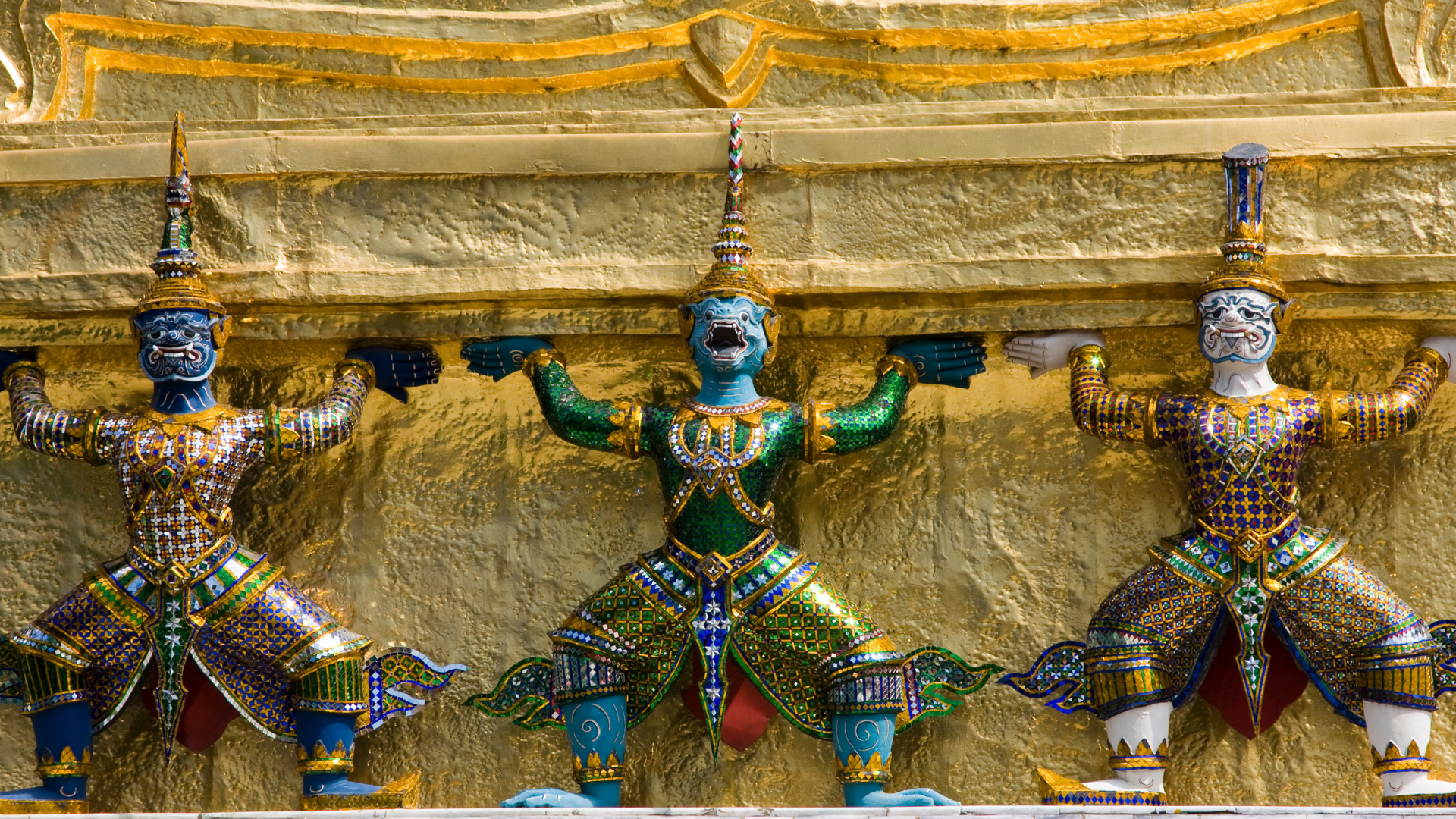
Just steps away from the main ordination hall stands one of the most mesmerising sights within Wat Phra Kaew, the Phra Si Rattana Chedi, a towering golden stupa whose base is dramatically supported by a ring of jewel encrusted figures.
These richly adorned beings, captured in a deep squat with arms raised skyward, appear to lift the stupa upon their shoulders. They are the yaksha, mythical giants, and Hanuman, like monkey warriors, drawn from the pages of the Ramakien, Thailand’s national epic rooted in the Ramayana. Their task isn’t merely physical, it is profoundly symbolic. In their theatrical poses, they guard and uphold the dharma, the sacred cosmic order, embodying both strength and service in devotion to the divine.
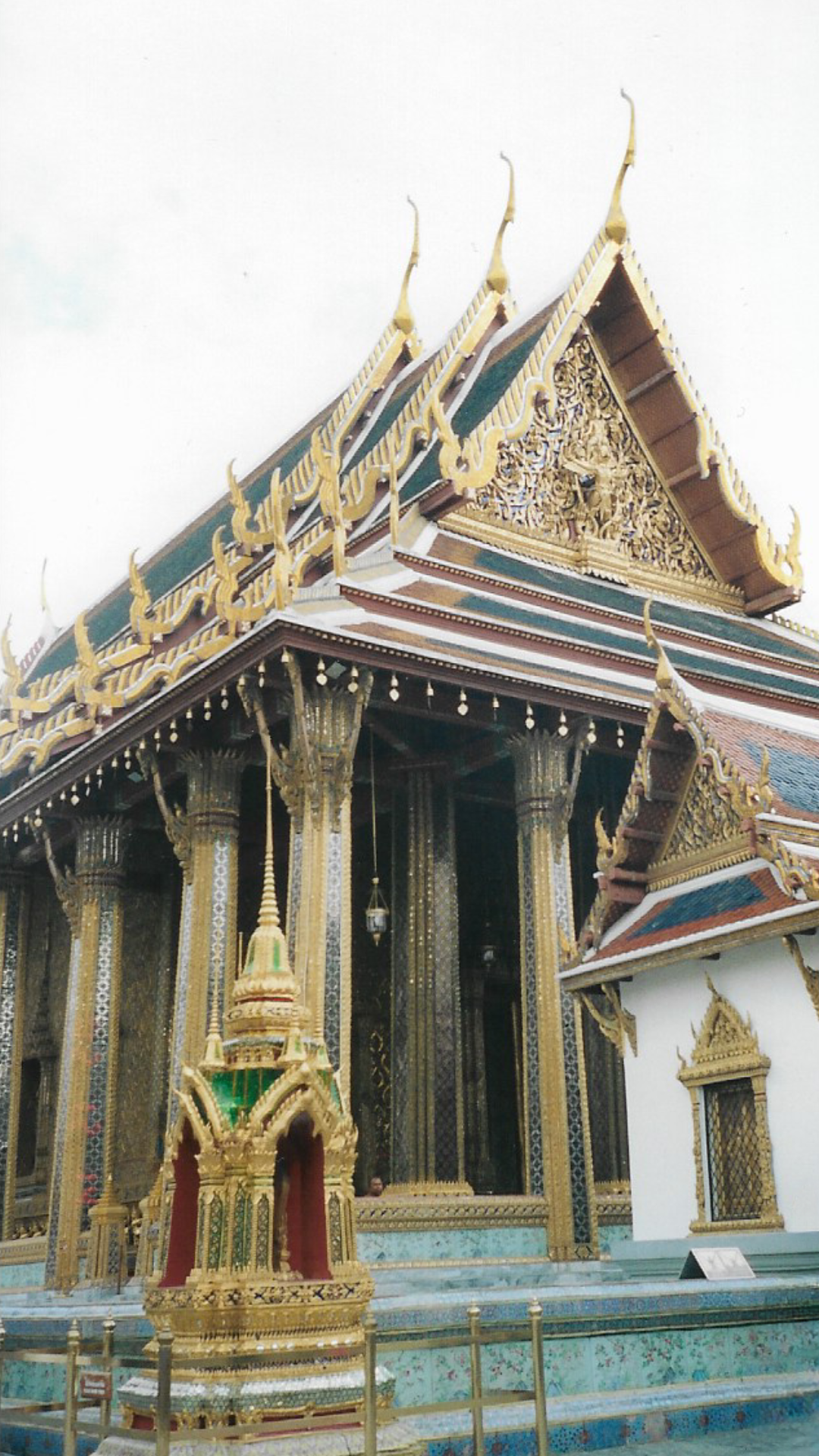
Also, nearby stands the Royal Pantheon, or Prasat Phra Thep Bidon, a refined structure crowned with a tall spire and elegantly tiered rooflines that gleam with gold, glass mosaic, and delicate carvings.
Originally constructed in the mid-19th c. during the reign of King Rama IV, it was intended to house the revered Emerald Buddha. However, it was ultimately deemed too small for the sacred statue, and the Emerald Buddha remained in the nearby Ubosot.
Today, the Royal Pantheon holds an equally dignified role, enshrining life sized statues of past Chakri dynasty kings, from Rama I to Rama VIII, each placed with deep respect and spiritual symbolism. The structure is only opened to the public once a year on Chakri Memorial Day, the 6th of April, in honour of the dynasty’s founding. Architecturally, it reflects a blend of Khmer and Thai influences with its towering central prasat resembling ancient Angkorian forms, while the decorative motifs remain firmly rooted in Thai royal aesthetics.
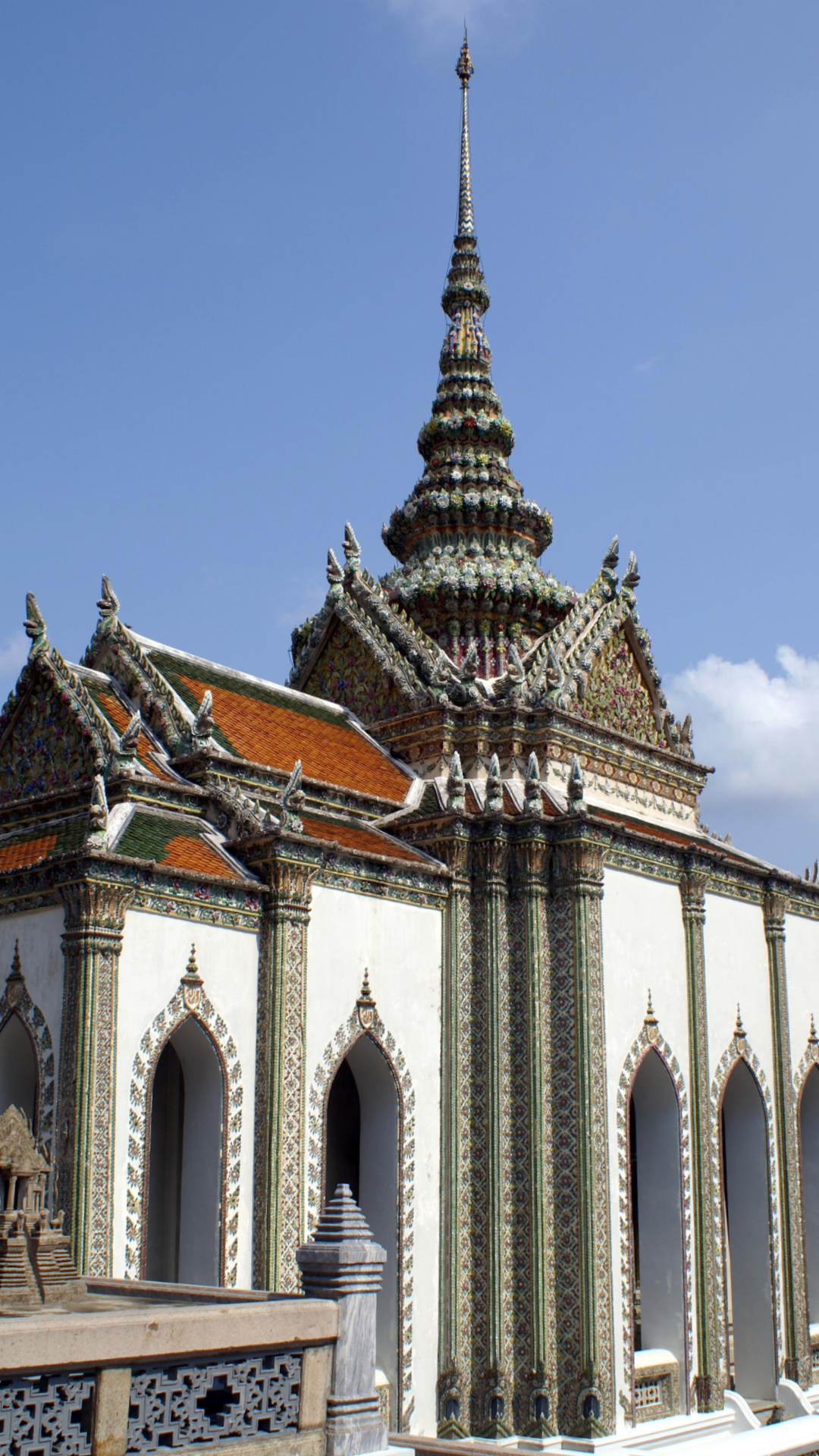
Also found within the grounds of the amazing Wat Phra Kaew, stands the Phra Viharn Yod a gem of beautiful Thai architecture.
Modest in scale compared to its golden neighbours, yet no less majestic, this elegant viharn, sermon hall is crowned with a delicate, multi-tiered spire that lifts the eye heavenward. Its name, translating to 'Viharn with a Spire,' reflects the grace of its tiered crown and finely carved gables with quiet splendour.
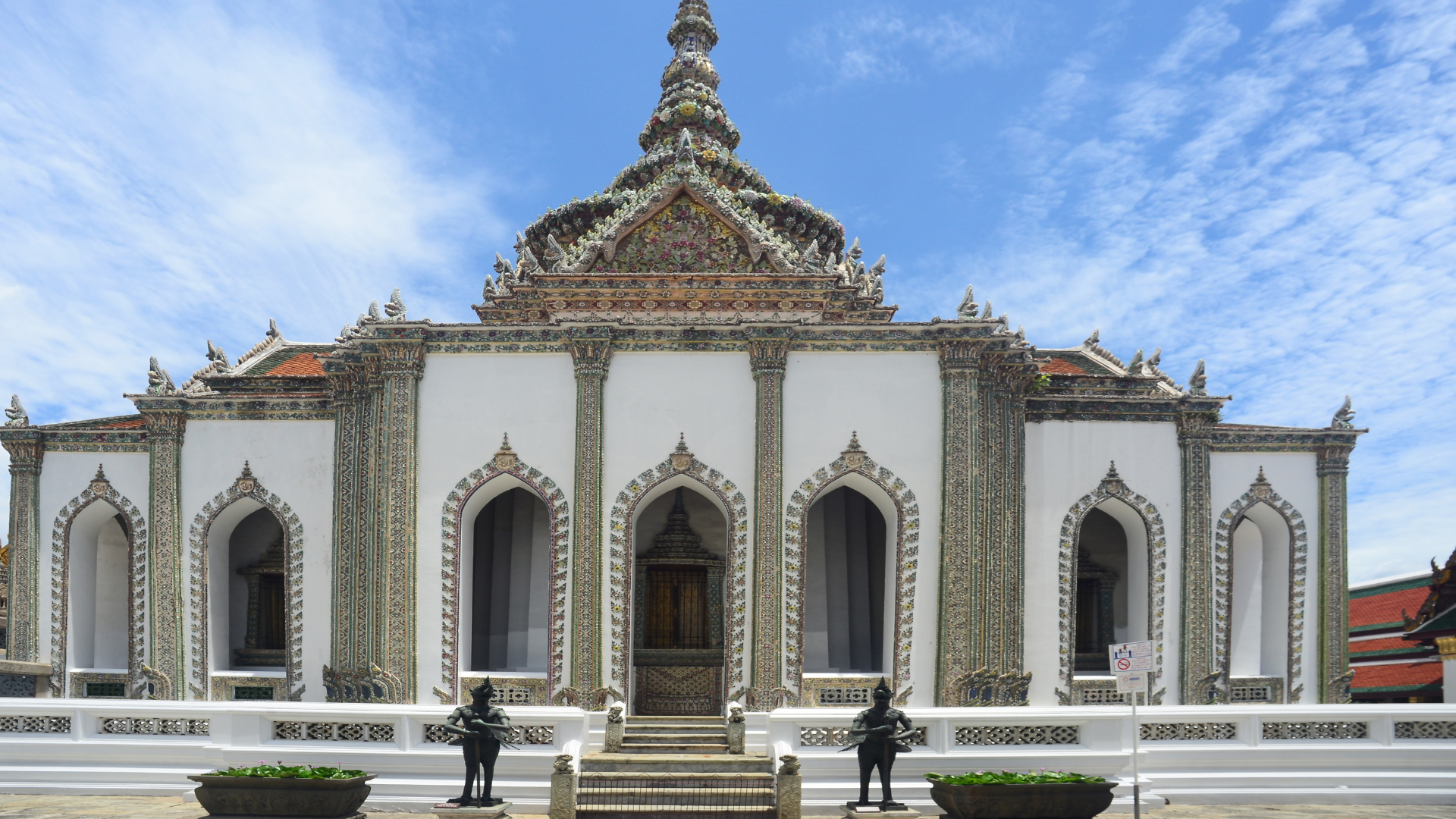
Guarding its entrance are striking figures of mythical beings, that are deeply embedded in Thai cosmology and storytelling. These statues, are likely kinnara or garuda, part human and part divine, are often overlooked, yet they hold symbolic weight. With their poised stance and otherworldly expressions, they are said to represent protectors of sacred space, silently ensuring that only purity and reverence pass through. Being photographed seated at the feet of one statue, their watchful presence feels almost like stepping into a liminal space with one foot in the material world, the other brushing against the realm of spirit and celestial order. In this quieter corner of the temple complex, there is a physical stillness, as though the stories of these mythical guardian’s whisper only to those who pause long enough to truly listen.
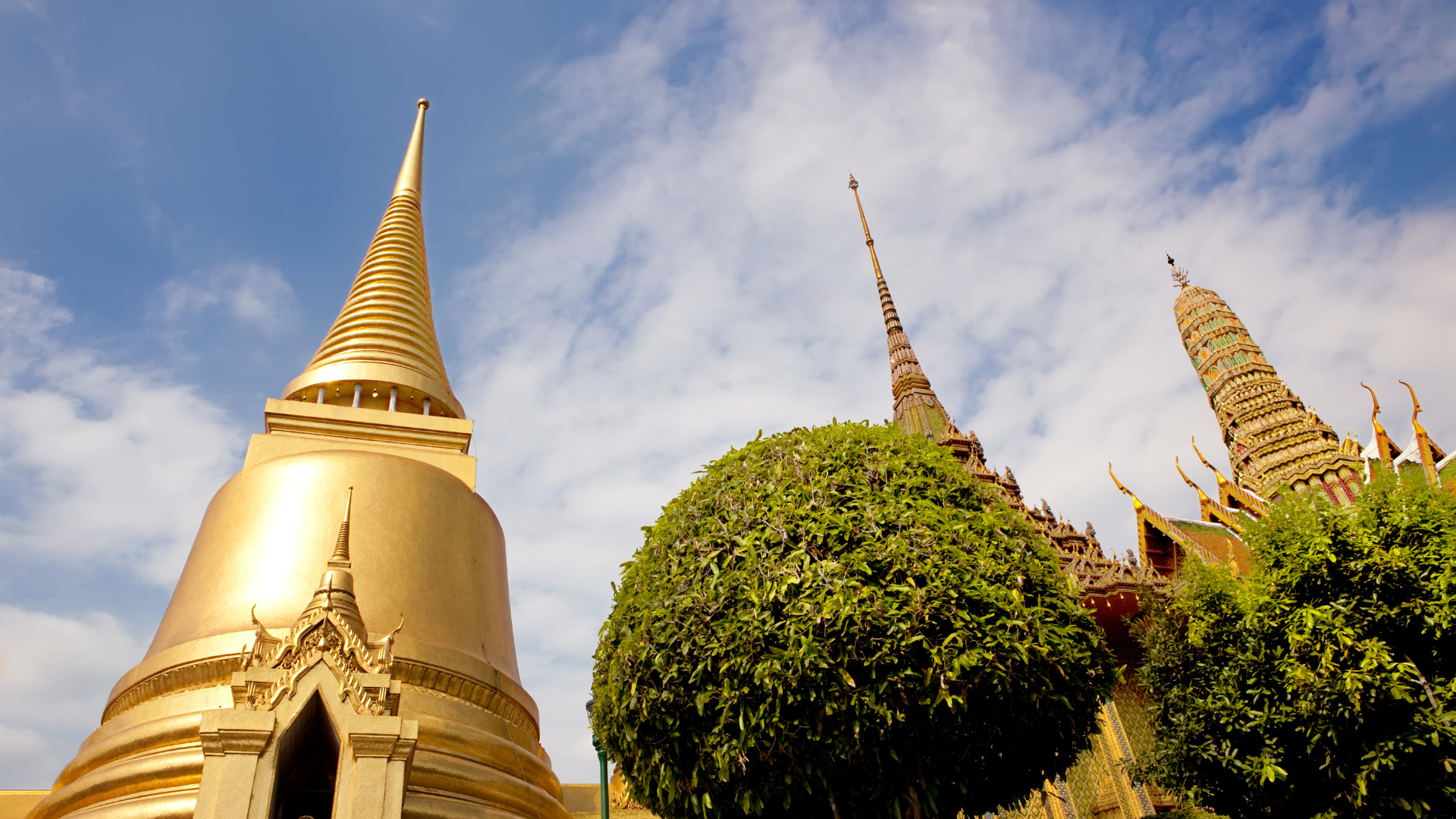
The Phra Viharn Yod is just a short walk to the golden splendour of the Phra Si Rattana Chedi, offering a contemplative contrast to the grandeur of its companions.
This golden stupa, was built in the mid-19th c. by King Rama IV to enshrine relics of the Buddha, believed to have been brought from Sri Lanka. Its bell shaped silhouette is a classic example of the Sri Lankan influence on Thai religious architecture, and it glows with thousands of tiny golden tiles that catch the sunlight throughout the day.
Together, these sacred buildings form a symbolic and visual journey, from the introspective grace of the Viharn Yod to the luminous promise of enlightenment embodied by the towering stupa. The spatial relationship between them, so close yet distinct, reflects the layered nature of devotion in Thai Buddhism, from inner contemplation to outward splendour.
Leaving behind the spiritual embrace of Wat Phra Kaew, we wandered in the direction of Wat Pho, another of Bangkok’s treasured sanctuaries. Walking across Sanam Luang, the manicured green lawn in front of Wat Phra Kaew and the historic ceremonial ground.
With Wat Phra Kaew embodying celestial kingship and leaving me in quiet awe, I was soon to be overawed once again at Wat Pho, where the atmosphere feels more grounded, inviting reflection and a certain gentle reverence.
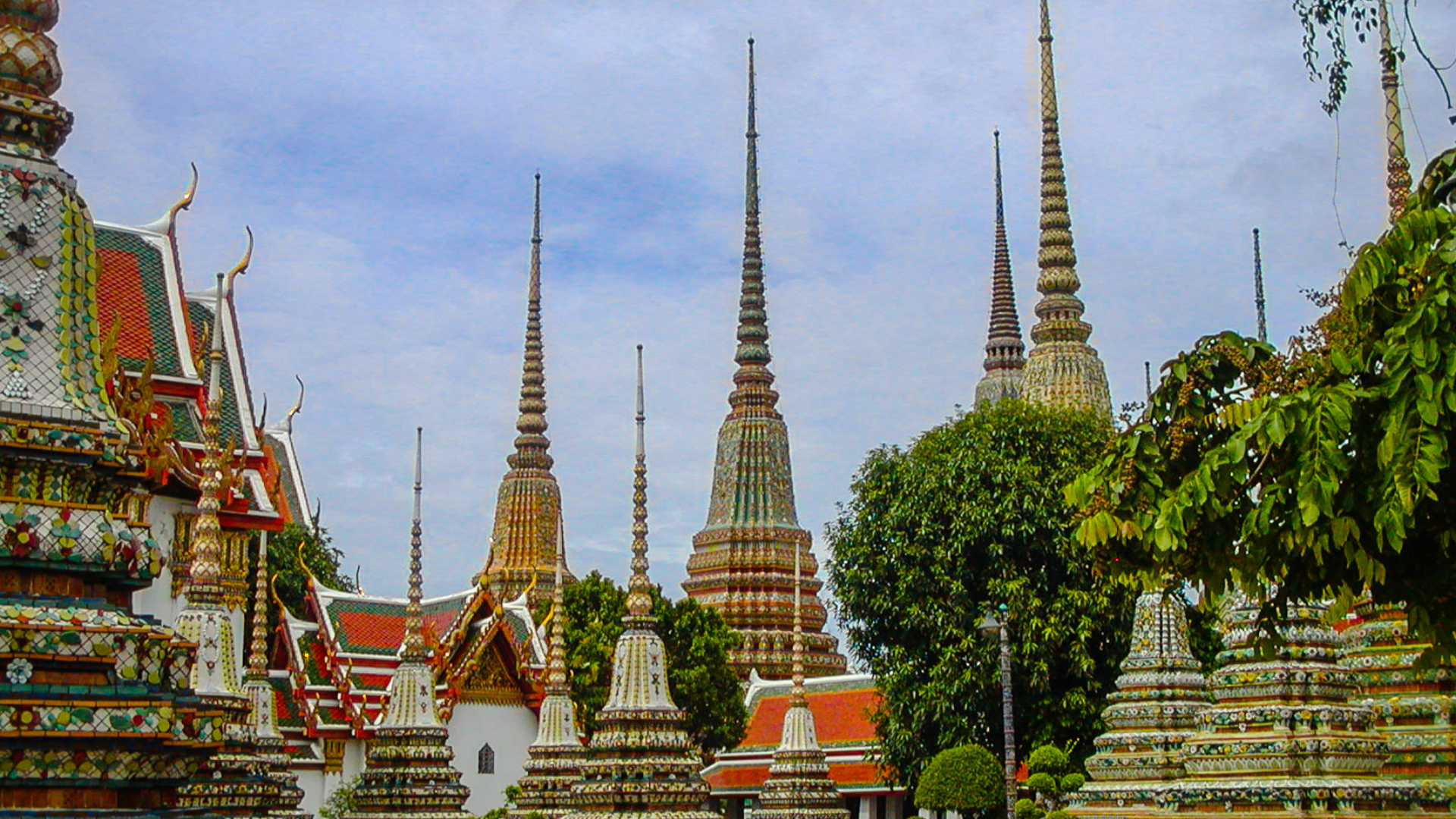
Within the grounds of Wat Pho, we found ourselves surrounded by a forest of beautiful stupas, with more than ninety stupas scattered across the temple grounds. Among them, the four largest, the Phra Maha Chedi Si Rajakarn stand especially proud, grouped together in honour of the first four kings of the Chakri dynasty.
Roaming among these richly decorated stupas, we eventually found ourselves before the Viharn Phra Buddhasaiyas, the grand hall that houses the awe-inspiring Reclining Buddha.
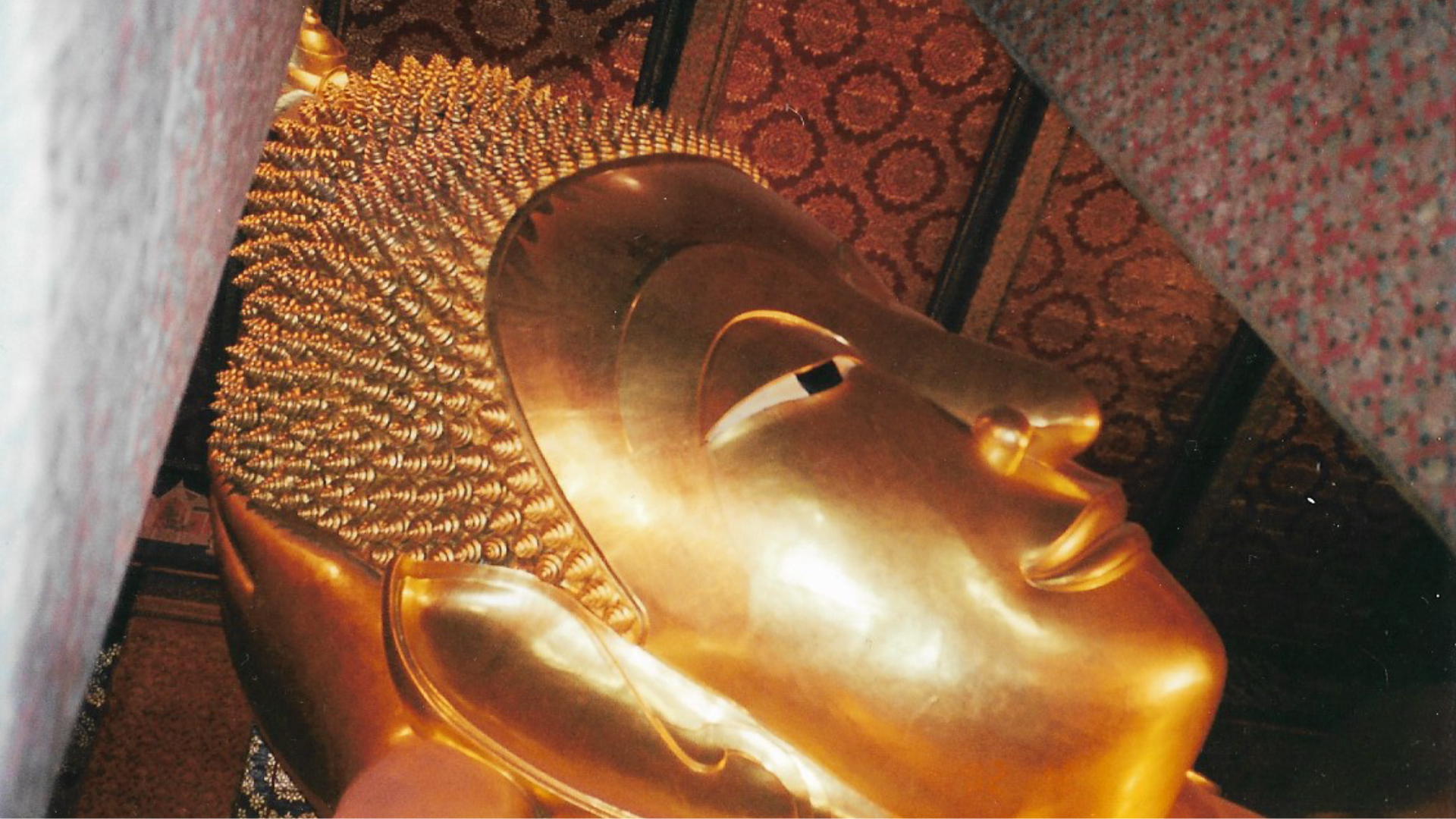
The Reclining Buddha is the largest of its kind in Bangkok and the third largest in all of Thailand. An awe-inspiring figure that instantly captures your attention, which holds one of the highest ranks of importance among Thai temples as a royal temple.
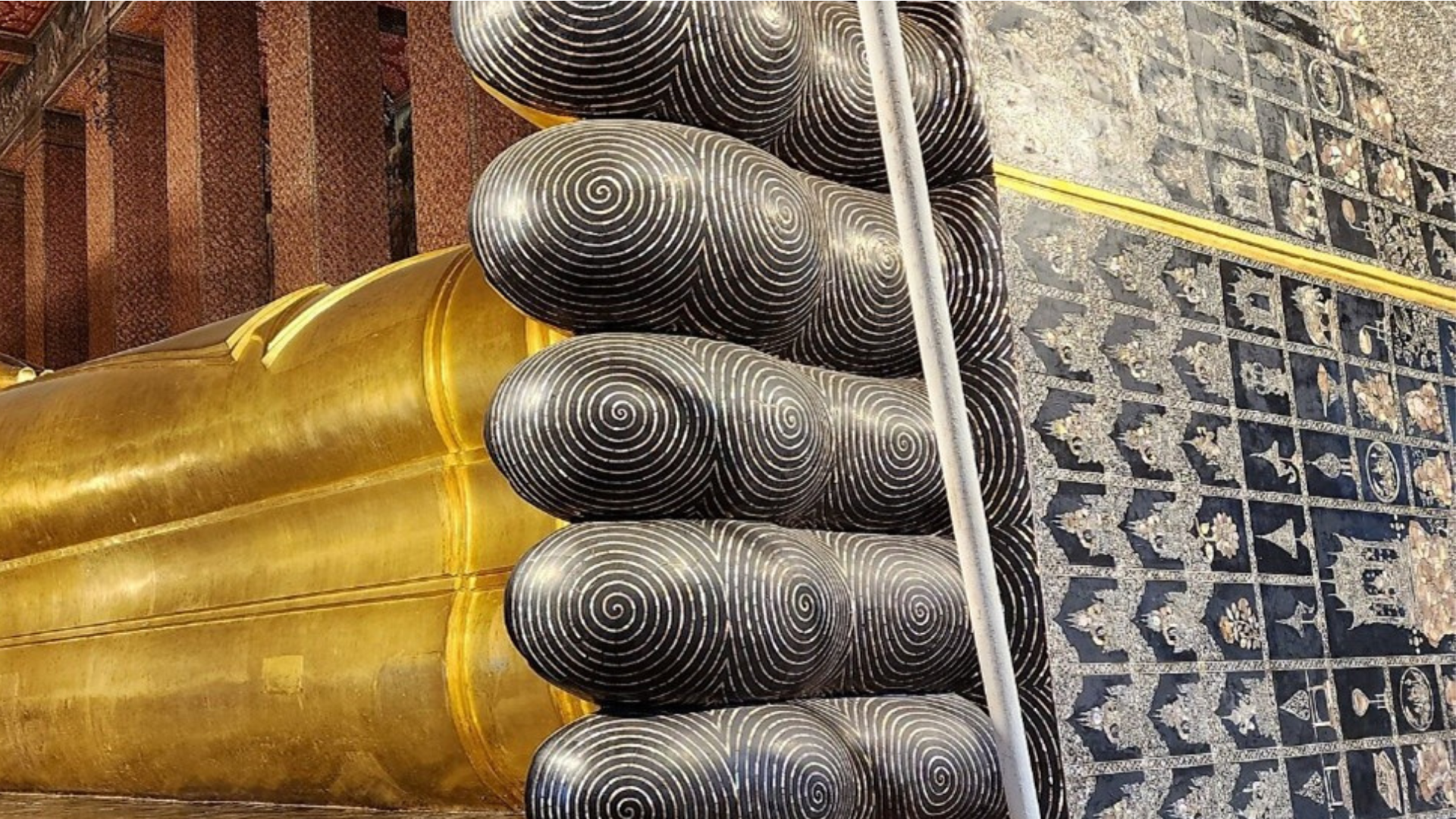
Every inch is breathtaking, but it is the soles of the Buddha’s feet that truly capture the imagination. Measuring three metres high and four and a half metres long, they are delicately inlaid with mother-of-pearl, masterpieces in their own right, depicting 108 auspicious symbols representing the Buddha’s journey towards enlightenment.
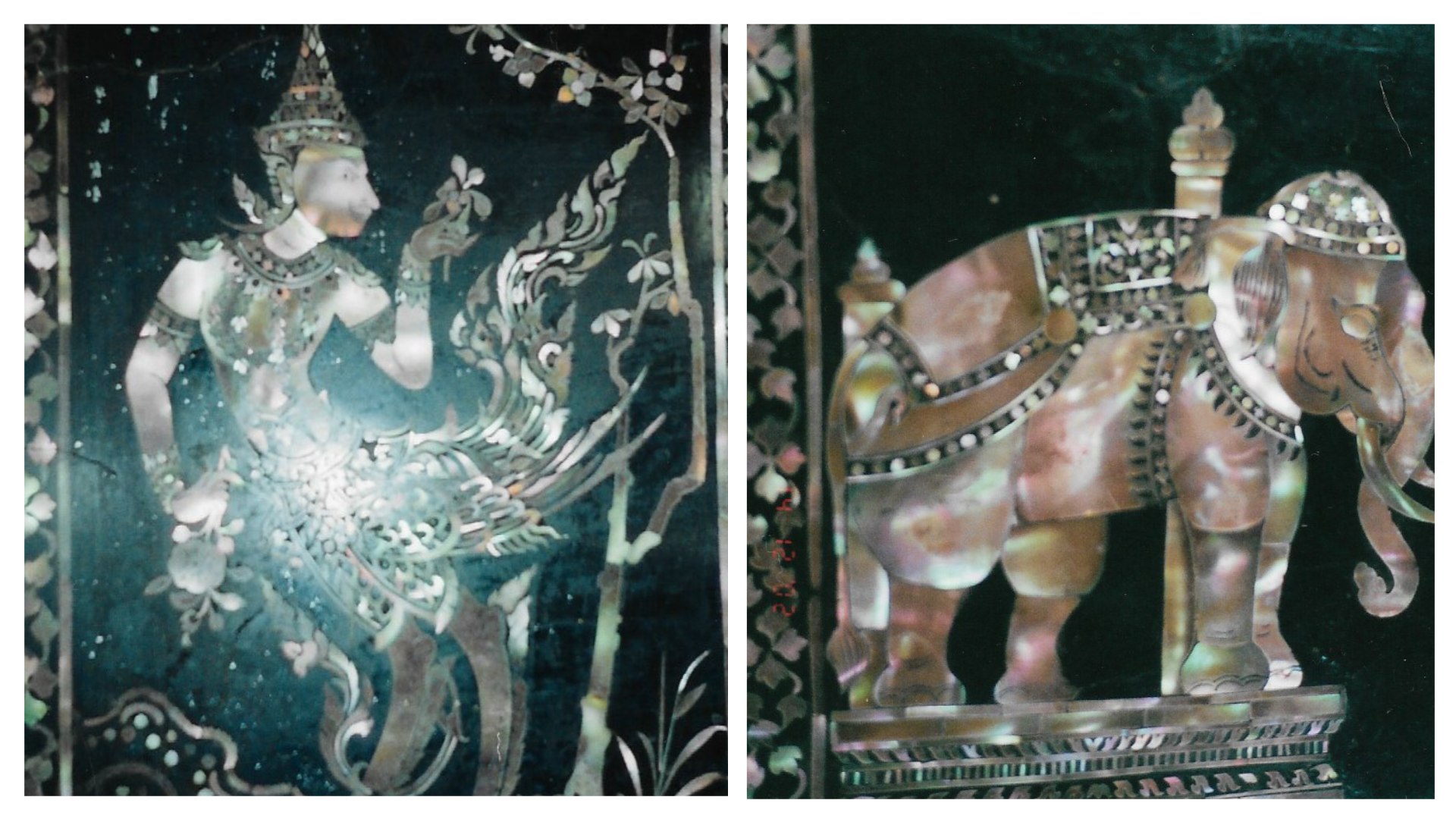
The detail is truly mesmerising: swirling lotus flowers, sacred elephants, mythological scenes, each tiny image forming part of a greater cosmic whole, like a celestial map. As you move slowly along the length of the hall, the sheer scale and intricate artistry draw you into a quiet, contemplative rhythm, blended with the sounds of coins being placed into the offering bowls lining the walls; an age old tradition believed to bring good fortune.
Yet it is not only the richness of the Reclining Buddha that enchants. The entire temple hall, with its towering mural paintings and rows of golden bowls, holds a magnificence of its own.
In essence, the Grand Palace is a city within a city, a sacred sanctuary that weaves together monarchy, religion, and national identity. The number of temples isn’t excessive, it’s expressive. Each one is a deliberate layer in a broader spiritual and historical landscape, etched into Thailand’s deep rooted reverence for the divine and the enduring role of the monarchy as protector and patron of the faith.
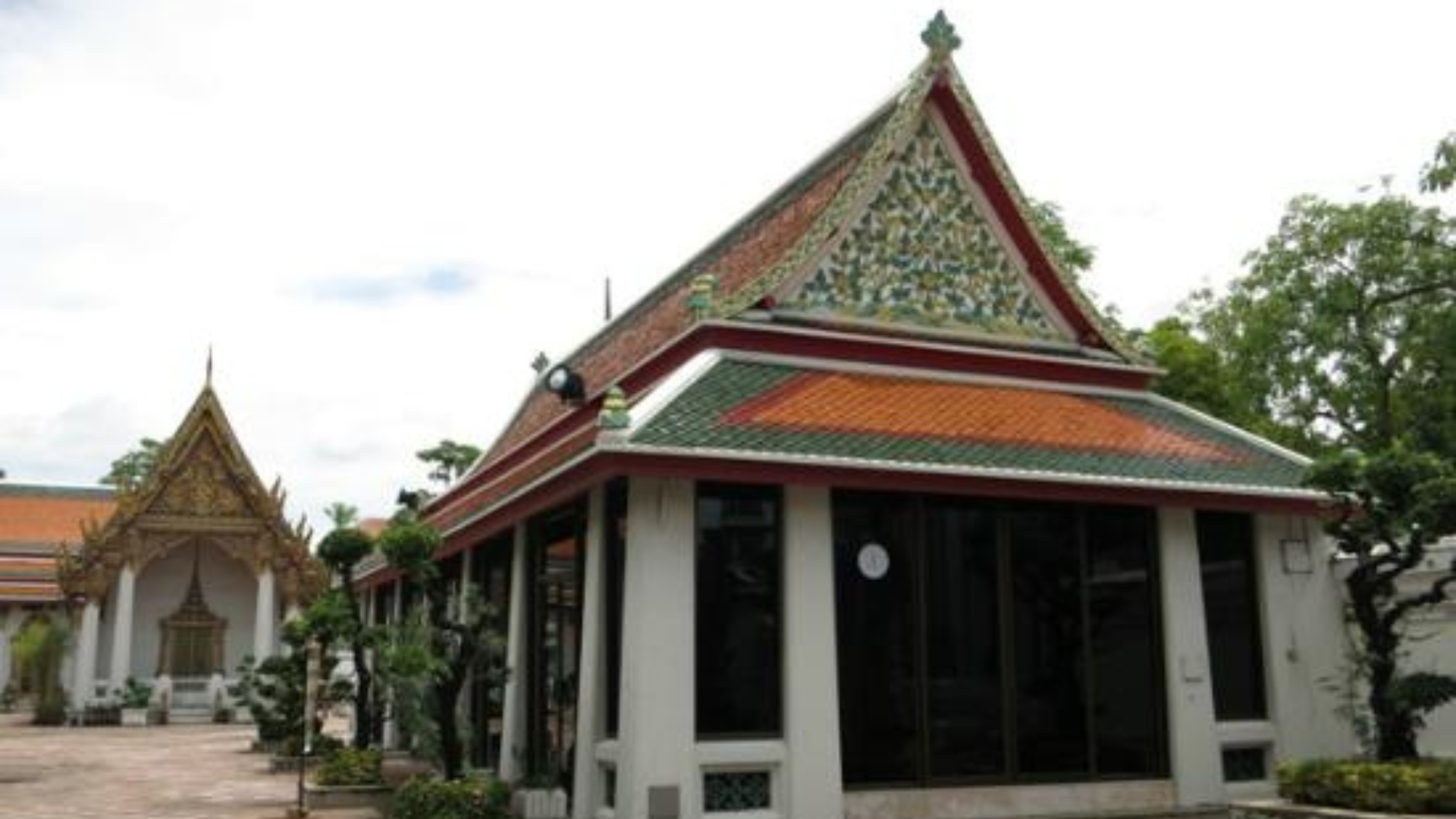
As we were preparing to depart, we noticed a Thai massage school within the grounds of Wat Pho. After a full day rich with gilded rooftops, whispered myths, and the silent grace of sacred halls, how could we resist? A spirited Thai massage revealed a surprising flexibility I never knew I possessed, with plenty of pummelling, pulling, and stretching for good measure.
Leaving the Grand Palace, and taking a taxi through Bangkok’s bustling streets, returning to the hotel in time to meet with other travellers and our tour leader. We shared an evening meal together along the lively stretch of Khao San Road, an enjoyable end to a memorable day.
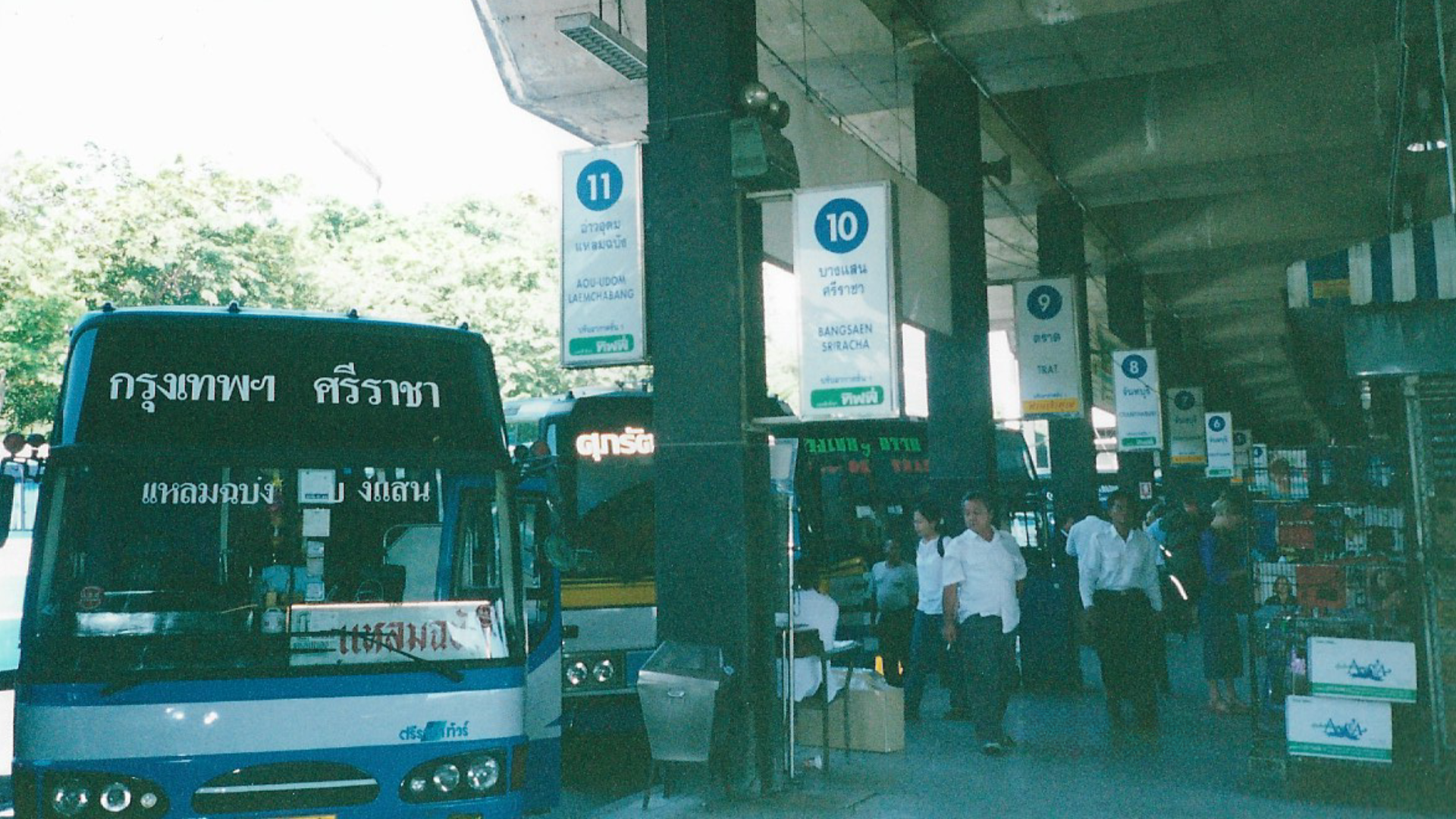
The following day, our group bundled into three taxis, headed for the Bangkok bus station for a five hour journey to the small border crossing town of Trat, and an overnight stay with time to check out the local night market, before transiting the border into Cambodia.
Looking back, my first journey to Southeast Asia, and to the spirited heart of Thailand, Bangkok feels like the opening pages of a new chapter. In those earlier years of travel, I was only beginning to embrace the language of astrology, and learning to stay open to the experiences and cultures that would soon shape the person I was becoming.
Though my stay in Bangkok was brief, it planted seeds that would continue to grow. I later discovered that a powerful Pluto placement had been quietly at work beneath the surface, encouraging me to integrate the worth and wonder of these new experiences into my sense of self. This profound energy was interwoven with an intersecting paran line with Mercury, lighting up my curiosity, quickness, and thirst for learning, subtle companions on my path.
It’s also here that Black Moon Lilith enters the story, an important point in astrological mapping, not a planet or body, but a mathematical point that carries deep, often unseen, energies. This point, entwined with Mercury, helped to quietly guide my personal style of communication, encouraging a graceful flow of curiosity and a deeper willingness to trust the unfolding journey of a woman eager to explore and experience more of our shared world.
Bangkok, with all its shimmering rooftops, busy streets, and soulful sanctuaries, marked not just the start of a journey across lands and borders, of which there have been many, but a more personal journey too: one of finding my voice, and learning to meet the unknown with wonder.
Sharing the day’s experiences with another traveller had been such a joy. The gift of having fun together, making lovely connections, and embracing the importance of meaningful conversation added another layer to this journey. Experiencing the architectural and spiritual connections from Wat to Wonder and Finding Peace in Bangkok’s Temples created a day rich in memory and meaning.
My travel companion shared one of her favourite little mantras, and it stayed with me:
"I'm alive, awake, alert, enthusiastic!
I'm alive, awake, alert, enthusiastic!
I'm alive, awake, alert,
I'm alert, awake, alive,
I'm alive, awake, alert, enthusiastic!"
In this Soul Travel blog of my journey through Thailand, and beyond into the heartlands of Southeast Asia, I explored some of the majestic temples of Bangkok, finding not only beauty and wonder, but a deeper sense of connection to the world and to myself.
See you soon,
Consider signing up to receive new Soul Travel blogs, travel reflections, and astrocartography insights as new destinations are shared.

✨ If this story resonated with you, you are warmly invited to continue the journey in a way that feels aligned with you.
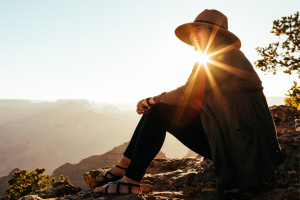
✨ Explore personalised insights through consultations
✨ Begin with ‘The Journey’ Orientation
✨ Listen to Destined Places podcast stories
✨ Save and share Soul Travel inspiration on Pinterest